
Postpartum Anxiety vs Normal New Mom Worry: How to Tell the Difference
Normal new mom worry comes and goes, attaches to specific things and eases as you get more confident. Postpartum anxiety stays. It is constant, hard to turn off, and it keeps going even when the baby is fine and you have a free minute to rest. If your worry is making it hard to sleep, eat, relax or enjoy your baby, it is worth talking to a provider.
Almost every new mother worries. You check that the baby is breathing. You wonder about feeding, sleep, weight, rashes, whether you’re doing any of this right. That is part of caring for a newborn. The tricky part is that postpartum anxiety starts out looking exactly like that, only louder and harder to shut off.
This post explains how the two differ, how postpartum anxiety compares to the baby blues and postpartum depression, what the symptoms look like, why intrusive thoughts happen, what treatment involves and when to call for help. It is written for new mothers, and for the partners and family members who are trying to work out whether what they’re seeing is normal.
What Is Postpartum Anxiety?
Postpartum anxiety is persistent worry, fear and physical anxiety symptoms that start after having a baby and get in the way of daily life. It can begin during pregnancy or at any point in the first year after birth.
It is common. About 1 in 5 women have an anxiety disorder during pregnancy or after delivery, and some research suggests that significant anxiety symptoms are as common as postpartum depression, or even more common. It just gets talked about less.
It is also treatable. Many women improve with therapy, and some also benefit from medication. Left alone, it can last for months or longer, so getting help sooner tends to be better than waiting it out.
What Does Normal New Mom Worry Look Like?
Normal worry has a few features in common. It tends to come and go instead of running all day. It usually connects to a specific situation, like the first night home, a cough, a feeding problem or going back to work. And it fades as you get used to being a parent and your confidence grows.
You can still function with it. You might lose some sleep to a worry, but you can usually settle, take a break and enjoy time with your baby. If someone reassures you, the worry eases.
A quick note on the phrase “mom instinct.” A lot of new mothers are told to trust their gut. That’s fair advice when your gut is calm and about something happening right now. Instinct tends to be quiet and rooted in the present moment. Anxiety tends to be loud and focused on what might go wrong in the future. If the alarm in your head is ringing all day, and nothing the baby does turns it off, that’s worth noticing.
How Is Postpartum Anxiety Different From Normal Worry?
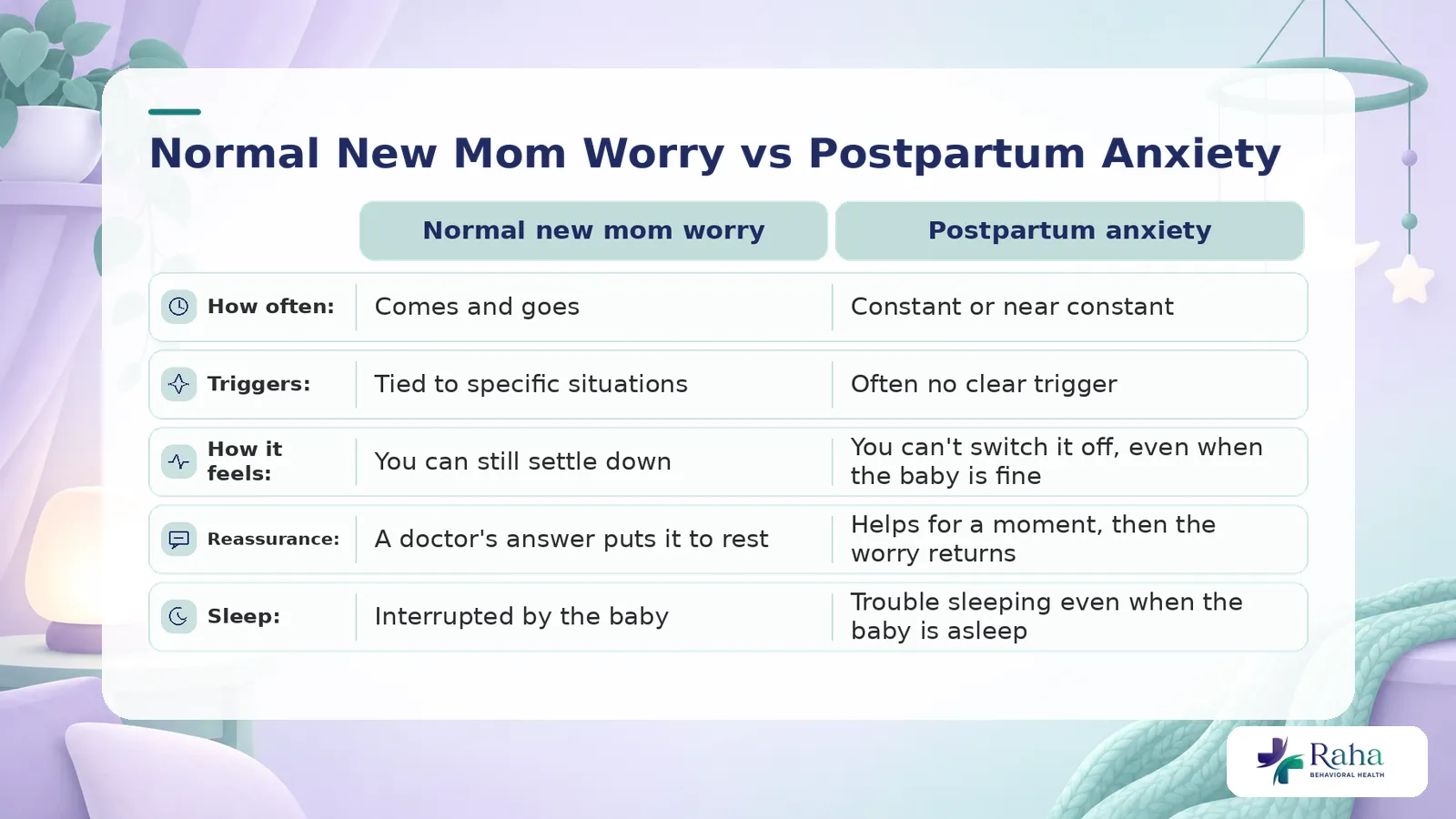
Here’s a side by side look. It is a general guide and not a diagnosis.
| Normal new mom worry | Postpartum anxiety | |
|---|---|---|
| How often | Comes and goes | Constant or near constant |
| Triggers | Tied to specific situations | Often there’s no clear trigger, or it jumps from one worry to the next |
| How it feels | You can still settle down and calm yourself | You can’t switch it off, even when the baby is fine |
| Reassurance | A doctor’s answer or a good night puts it to rest | Reassurance helps for a moment, then the worry returns |
| Over time | Eases as you gain confidence | Stays the same or gets worse |
| Sleep | Interrupted by the baby | Trouble sleeping even when the baby is asleep |
| Daily life | You can still eat, take care of the baby and do your routine | Eating, sleeping, bonding or going out starts to suffer |
Three things matter most: how often, how intense and how much it gets in the way. Worry that is frequent, strong and disruptive is a different thing from worry that is occasional, proportionate and manageable.
What Are the Symptoms of Postpartum Anxiety?
They show up in the mind, the body and your behavior.
In your thoughts and feelings
- Constant, intense worry, often about feeding, crying, breathing or the baby’s health, that goes on day and night
- Feeling on edge, tense or irritable
- A sense of dread, as if something bad is about to happen
- Guilt or shame about how you’re feeling
- Intrusive “worst case” thoughts, including thoughts about something happening to the baby
In your body
- Trouble sleeping even when the baby sleeps
- A racing heart
- Sweating
- Shortness of breath
- Muscle tension
- Headaches
- Stomach upset, nausea or a lower appetite
Many of these also show up with anxiety at other times in life. Our post on the physical symptoms of anxiety goes through them in more detail.
In what you do
- Checking on the baby again and again
- Asking others for reassurance, over and over
- Researching every decision for hours
- Avoiding being alone with the baby
- Avoiding leaving the house
Some women hide these behaviors well. From the outside they look like a careful, attentive mother. On the inside, it feels like running on a motor that won’t shut off. If that sounds familiar, you aren’t weak and you aren’t failing.
Panic attacks
Postpartum anxiety can also bring panic attacks, which are sudden, intense episodes with a pounding heart, a feeling of doom, shortness of breath and dizziness. If those sound familiar, panic attacks and anxiety attacks are worth reading about too.
How Is Postpartum Anxiety Different From the Baby Blues?
The baby blues are very common, and they come from the sharp drop in hormones after delivery. They bring sadness, weepiness, feeling overwhelmed, mood swings and trouble sleeping. They are usually mild.
The biggest difference is timing. The baby blues tend to peak a few days after birth and fade within about two weeks. They don’t stop you from caring for yourself or your baby, and most of the time you still feel like yourself.
Postpartum anxiety doesn’t fade on that schedule. If the worry, restlessness or physical symptoms are still there after the first couple of weeks, or they’re getting stronger, that’s the point to ask for an evaluation.
How Is Postpartum Anxiety Different From Postpartum Depression?
They overlap a lot, and a person can have both. Sleep trouble, trouble relaxing and irritability show up in each one.
The center of each is different. Postpartum depression is mainly about low mood, sadness, hopelessness and loss of interest. Postpartum anxiety is mainly about worry, racing thoughts and tension. Many women with postpartum depression also feel anxious, but not every anxious mother is depressed.
The difference matters for treatment. Anxiety may not respond as well to some treatments built for depression, so it helps to name it correctly. Our post on depression and anxiety explains how the two compare, and depression in women covers the signs of depression in more depth.
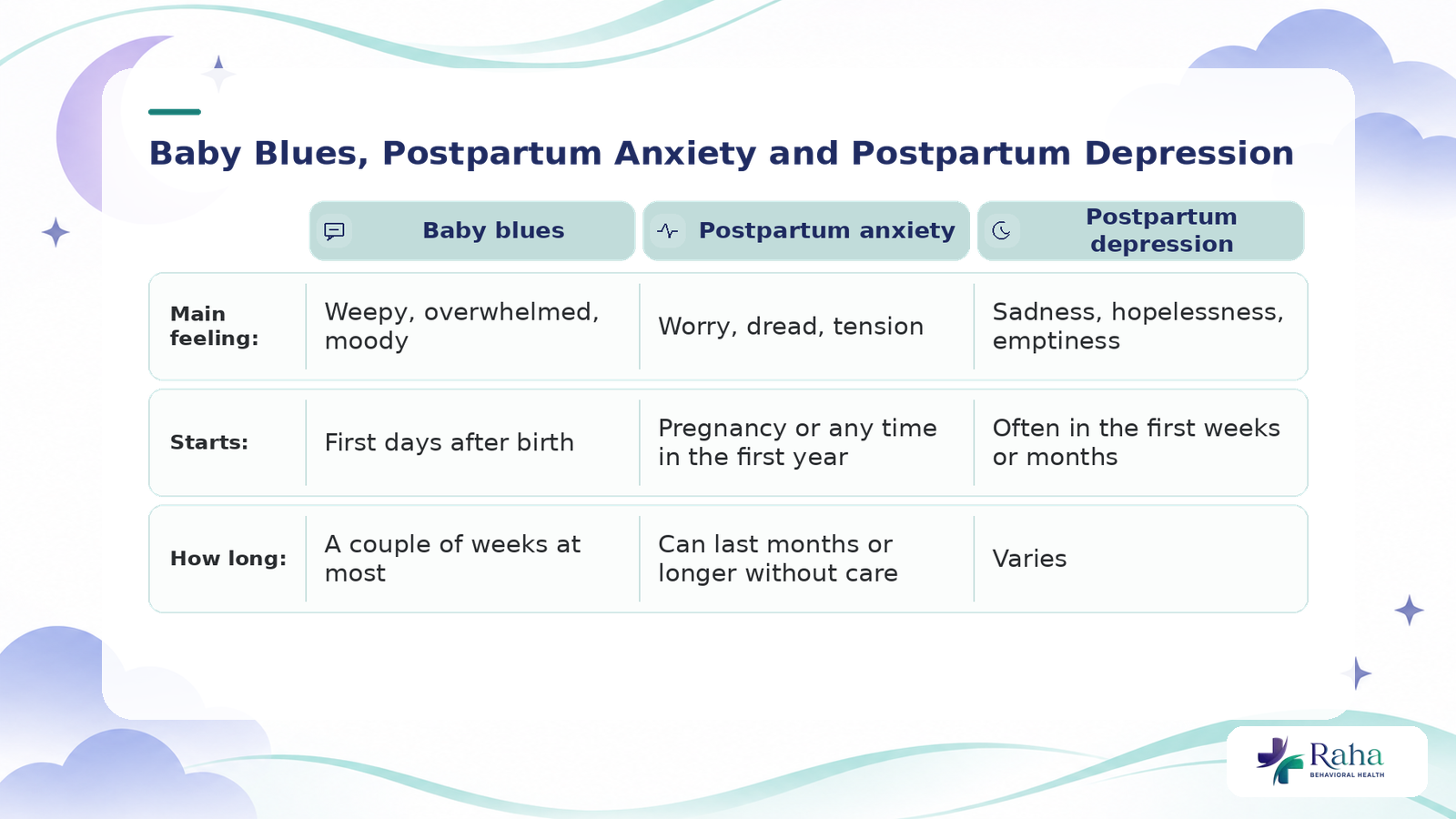
| Baby blues | Postpartum anxiety | Postpartum depression | |
|---|---|---|---|
| Main feeling | Weepy, overwhelmed, moody | Worry, dread, tension | Sadness, hopelessness, emptiness |
| Starts | First days after birth | Pregnancy or any time in the first year | Often in the first weeks or months, can start later |
| How long | A couple of weeks at most | Can last months or longer without care | Varies, with no fixed length |
| Daily life | Usually still manageable | Sleep, eating, bonding or leaving home can suffer | Caring for yourself or the baby can feel too hard |
| Needs care? | Usually fades on its own, tell a provider if it doesn’t | Yes, it is treatable | Yes, it is treatable |
Why Do Intrusive Thoughts Happen After Having a Baby?
Intrusive thoughts are unwanted, upsetting thoughts or images that pop into your head. After a baby, they often involve something bad happening to the baby: dropping them, an accident, someone harming them, or even you harming them.
These thoughts are frightening, and many mothers never say them out loud because they’re scared of what it means. So here is the plain version. Intrusive thoughts are common with anxiety. They are a symptom, not a wish or a warning. When they come from an anxiety disorder, mothers are extremely unlikely to act on them. The fact that they scare you is part of what separates them from intent.
Intrusive thoughts can come with compulsions, which are things you do to ease the distress, like checking, cleaning or avoiding. When both are present, it’s sometimes a sign of postpartum OCD, which is treated differently from other anxiety. If you recognize this pattern, our OCD treatment page explains how it is approached.
That said, some situations need urgent help right away. Get help immediately if you have thoughts of harming yourself or your baby that feel real and not like unwanted intrusions, if you can’t care for yourself or your baby, or if you feel confused, lost or out of touch with reality. See the section on getting help below.
Why Does Postpartum Anxiety Happen?
There is rarely one cause. Several things can pile on top of each other:
- Hormone changes. Hormones swing hard after pregnancy and can set off or strengthen anxiety. Hormones shift again after weaning from breastfeeding.
- Real stress. The baby’s health, money pressure, new roles in a relationship and sleep loss are all real stressors, not imagined ones.
- A history of pregnancy loss. A miscarriage or stillbirth raises the risk.
- Earlier anxiety. If you had anxiety before or during pregnancy, it can come back after delivery. If you’ve never had it before, you can still get it.
- Lack of support. Going without help at home or having no one to talk to makes everything heavier.
None of this is about being a weak or unprepared parent. It is a medical condition that can happen to anyone. You may also notice that it lines up with other parts of life changing at once, which our post on major life changes talks about. And when worry keeps your mind busy at all hours, it can leave you feeling mentally overloaded.
How Long Does Postpartum Anxiety Last?
There is no fixed timeline. Without treatment it can last months or longer. With treatment, most women improve significantly. It tends to be better to ask for help early than to wait and see.
How long it takes to feel better depends on you and on what kind of care you get, which is why a provider usually talks through a timeline once a plan is in place. For a general idea of how care for anxiety tends to move, see how long anxiety treatment takes.
What Does Treatment for Postpartum Anxiety Look Like?
Care is built around your symptoms, how strong they are and what you want. A typical path looks like this.
It starts with an evaluation. A provider asks about your symptoms, your sleep, your history, how long things have been going on and how they affect your day. This is also where you can bring up intrusive thoughts. A good provider takes them seriously without being alarmed.
Therapy is often the first step. Cognitive behavioral therapy (CBT) is one of the best studied treatments for anxiety. It works on the link between anxious thoughts, feelings and behaviors. For postpartum OCD, a type of CBT called exposure and response prevention is used. If you’d like to know more about how this therapy works, read about cognitive behavioral therapy.
Medication is an option when it’s needed. Some women need it, especially if symptoms are strong or they get in the way of sleep, bonding or daily life. SSRIs are the most commonly used class for anxiety. Therapy and medication can also be combined, and combining them often works better than medication alone. If you want an overview, medication management explains how that kind of care works, and anxiety medication explained goes through the main classes.
What about breastfeeding? This is one of the most common worries, and it’s a fair one. Medicines can pass into breast milk, often in low amounts. Several medicines are considered compatible with breastfeeding, and your prescriber weighs the details for you, including how strong your symptoms are, what has worked before and how your baby is doing. Don’t stop or start anything on your own. Ask the question out loud at your appointment.
Not sure whether you need medication or therapy? This post on deciding between medication and therapy walks through how people usually make that choice, and anxiety treatment without medication covers what care looks like without it.
At Raha Behavioral Health, postpartum anxiety treatment includes therapy, medication management or both together, and your partner can take part with your consent. We can also coordinate with your OB/GYN, midwife or your baby’s pediatrician, again with your consent.
What Can You Do at Home While You Get Support?
These steps support treatment. They don’t replace it when anxiety is strong, but they can take the edge off.
- Protect your sleep. Try to get at least one uninterrupted stretch of about four hours. Taking shifts with a partner or sleeping in separate rooms for a few nights can make that possible. Cut back on caffeine. If sleep won’t come even when you have the chance, persistent sleep problems can be a sign of something more, and our insomnia treatment page explains the options.
- Hold your baby close. Cuddling releases oxytocin, which can lower anxiety.
- Talk to other mothers. In person or online. Hearing that someone else had the same thought can be a huge relief.
- Move your body. Regular activity, especially breathing based practices like yoga, may help.
- Ask for help with the house. Let people cook, clean, run errands and hold the baby. Say it in specific terms: “Can you take the baby from 2 to 4 so I can sleep?”
- Use simple calming tools. If you’re always wound up, our guide on how to stop worrying about everything has practical ideas.
- Wean gradually, if you’re weaning. A slow change gives your body time to adjust.
When Should You Get Help for Postpartum Anxiety?
Reach out to a provider if any of these are true:
- Your worry is still there after the first two weeks, or it’s getting stronger
- You can’t sleep even when the baby is asleep
- You’re avoiding being alone with your baby or leaving the house
- You’re checking on the baby so often that it’s taking over your day
- You’re having panic attacks
- Your eating, sleeping, work or relationships are suffering
- Family or friends have said they’re worried about you
- You just feel that something isn’t right
That last one counts. If you’re unsure, our post on when to seek professional mental health care can help you decide. You can start with your OB/GYN, midwife, primary care provider or a mental health provider. You don’t need to have the right words.
When it’s urgent
Get help right away, today, if you have:
- Thoughts of harming yourself or your baby that feel real
- Trouble caring for yourself or your baby
- Confusion, or feeling lost and out of touch with reality
A rare condition called postpartum psychosis can start suddenly, usually within the first week after delivery, and it is an emergency. Call or text 988, call 911 or go to the nearest emergency room.
If you’re struggling and want to talk to someone, the National Maternal Mental Health Hotline is free, confidential and open 24 hours a day, every day. Call or text 1-833-852-6262 (1-833-TLC-MAMA). It is not an emergency line, so in a crisis, call or text 988.
How Can Partners and Family Help?
Partners and family often notice before the mother does. A few things that help:
- Listen without fixing. “That sounds exhausting” lands better than “you’re overthinking.”
- Notice repeated reassurance seeking. Asking the same question again and again is a common anxiety behavior. Gently suggest talking to a provider.
- Take real tasks off her plate. Night shifts, meals, laundry and visitors.
- Watch for the signs above. Especially trouble sleeping, avoiding the baby or leaving home, and panic.
- Look after yourself too. Partners can develop depression or anxiety after a baby, and the same kinds of support help them. If it’s you, talk to a provider.
- Offer to come to an appointment. If she wants you there, being in the room can make it easier for her to say what’s going on.
Strain between partners is common during this stretch, and it can make worry worse. Our posts on relationship stress and couples counseling cover that side of it.
Frequently Asked Questions
What are the first signs of postpartum anxiety?
Constant worry you can’t switch off is usually the first sign, often about the baby’s health, feeding or safety. Along with it come trouble sleeping even when the baby sleeps, a racing heart, feeling on edge, and checking on the baby again and again. Because it looks like normal worry at first, many mothers don’t notice the shift until it has been going for weeks.
How do I know if my worry is normal or postpartum anxiety?
Look at how often it happens, how strong it is and how much it affects your day. Normal worry comes and goes, connects to specific things and eases with reassurance or time. Postpartum anxiety is constant, hard to turn off and gets in the way of sleep, eating, bonding or leaving the house. If you’re unsure, a short conversation with a provider can sort it out.
Can you have postpartum anxiety without postpartum depression?
Yes. They overlap, and many mothers with depression also have anxiety, but not every anxious mother is depressed. You can have postpartum anxiety alone. Because the two need slightly different care, it helps to describe all of your symptoms, not just the sadness.
When does postpartum anxiety start?
It can start during pregnancy or at any time in the first year after delivery. Some mothers notice it in the first couple of weeks. Others don’t feel it until months later, sometimes around returning to work or weaning.
Are intrusive thoughts about my baby a sign I'm a bad mother?
No. They are a common symptom of anxiety and OCD, and they are treatable. When they come from anxiety, mothers are extremely unlikely to act on them, and being upset by them is part of why they feel so awful. Tell your provider. If the thoughts feel real, or you’re afraid you might act on them, get help right away.
How long does postpartum anxiety last?
There isn’t a set length. Without treatment it can last for months or longer. With treatment, most women get much better. Starting care early is usually easier than waiting.
Can I take medication for postpartum anxiety while breastfeeding?
Often, yes. Several medicines are considered compatible with breastfeeding, and only low levels of some pass into milk. Your prescriber looks at your symptoms, your history and your baby before recommending anything. Don’t start or stop a medicine on your own.
Is postpartum anxiety treatable without medication?
Yes, for many women. Cognitive behavioral therapy is a main treatment, along with sleep protection, support from other mothers, movement and help at home. Medication is added when symptoms are strong or therapy alone isn’t enough.
Can dads or partners get postpartum anxiety?
Yes. Partners can develop depression or anxiety during pregnancy or after the baby is born. If you’re a partner and you’re struggling, talk to a provider. The same kinds of support help.
Who should I talk to first?
Start with whoever you feel most comfortable with: your OB/GYN, midwife, primary care provider or a mental health provider. If you’re in a crisis, call or text 988.
Getting Support for Postpartum Anxiety
You don’t have to prove it’s bad enough before you ask for help. If your worry feels bigger than the moment, if you can’t turn it off, or if you simply feel like something is wrong, that is reason enough.
At Raha Behavioral Health, our postpartum anxiety treatment is open to mothers up to about a year after delivery, whether or not you had anxiety before. We offer in person visits in Houston and telehealth for eligible patients, which can make it easier to get care with a newborn. You can also learn more about our broader anxiety treatment, our care for generalized anxiety and our women’s mental health services, meet our providers, or request an appointment. If you have questions first, contact us.
Disclaimer: This article is for general information and does not replace medical advice, diagnosis or treatment. Only a licensed provider can diagnose postpartum anxiety. If you are in crisis or having thoughts of harming yourself or your baby, call or text 988, call 911 or go to the nearest emergency room.
Sources
- Harvard Health Publishing. Postpartum anxiety: an invisible disorder that can affect new mothers
- Massachusetts General Hospital Center for Women’s Mental Health. Postpartum anxiety
- Mayo Clinic. Postpartum depression: symptoms and causes
- Office on Women’s Health. Postpartum depression
- Health Resources and Services Administration. National Maternal Mental Health Hotline
- Psychology Today. Is it mother’s intuition or postpartum anxiety?
- HealthPartners. Signs and symptoms of postpartum depression and anxiety
- Healthline. Postpartum anxiety
- Alberta Health Services. Baby blues