
Short answer, yes. Anxiety can be treated without medication, and for many people therapy is the way in. The best studied kind is cognitive behavioral therapy (CBT), usually with some exposure work folded in. Day to day habits like breathing, moving more and sleeping better help alongside it. What they can’t do is take the place of treatment once anxiety is running your life.
That last bit gets skipped a lot. Plenty of “natural cure” articles make it sound like a few lifestyle tweaks will do the job. They won’t, not for an anxiety disorder. Habits help. Therapy treats. And medication is one more option that some people use and some don’t. This post sticks to the non-medication side: what it involves, what the evidence says, and how to tell whether it’s enough for you.
Can you treat anxiety without medication?
You can. Anxiety disorders are treated mainly with psychotherapy, medication, or both, and which one fits depends on the kind of anxiety, how strong it is, your health and what you’d rather do. So starting with therapy isn’t a workaround. It’s a normal, legitimate path.
In the UK, in fact, talking therapy (usually CBT) is the standard first step for generalized anxiety, and medicine comes after therapy has been tried. Other places order things differently. Either way, therapy isn’t the “lesser” choice.
Now the caveats, because there are a few.
Lifestyle changes on their own usually fall short. Exercise, better sleep and less caffeine can lower anxiety next to real treatment. They don’t replace it.
And “without medication” shouldn’t harden into “no matter what.” Say you’ve been in therapy for a good while and you’re still struggling. Or the anxiety is so heavy you can’t get started. Talking through medication with a provider then isn’t failing. It’s just more information. Finding the right approach sometimes takes a bit of trial and error, and that’s normal.
What is the main non-medication treatment for anxiety?
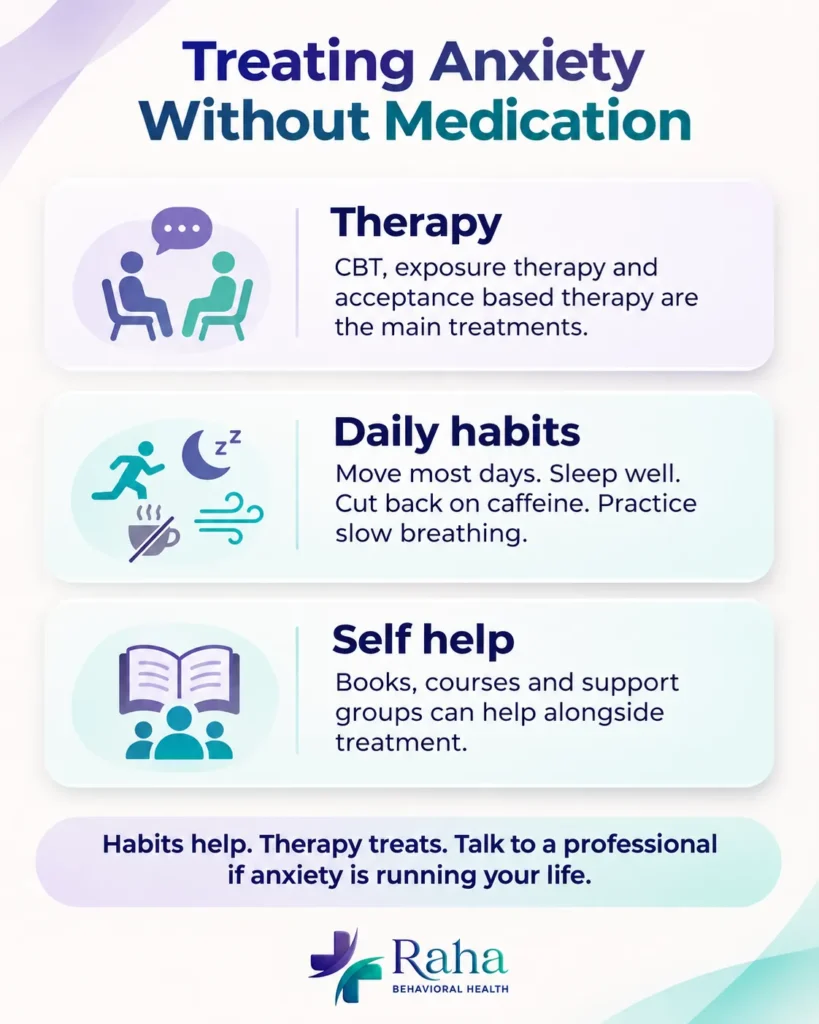
Therapy. A few kinds, actually.
CBT has the deepest research behind it. It’s generally short-term, and it’s described as the most effective form of psychotherapy for anxiety disorders. Exposure therapy lives inside it. Acceptance and commitment therapy (ACT) is a different flavor with some overlap. And ordinary supportive talk therapy has a place too, especially if you need room to sort out what’s going on before you start working on it.
You can do any of this in person or over secure video. If you’re in the Houston area, cognitive behavioral therapy in Houston and adult psychotherapy are the two to start with, and the anxiety treatment page shows how they fit together.
What happens in the first therapy session for anxiety?
Mostly talking, and mostly your therapist getting to know you. Nobody’s going to hand you a scary task on day one.
They’ll usually ask what brought you in, what the anxiety feels like, how long it’s been around, and how it’s messing with your days. Sleep, appetite, work, relationships, who supports you. That can take more than one visit, and it’s fine if you don’t have neat answers. Plenty of people don’t.
By the end of the first few sessions you should have a clearer picture of what’s happening and a plan with goals you’ve set together. Those goals tend to be concrete. Go to the grocery store without leaving early. Sleep through the night more often. Stop checking your phone every ten minutes. Some therapists write them down so you can both see progress.
It’s also your chance to check the fit. Ask how many sessions they expect, how they’ll measure progress, and what happens if things aren’t moving. A good therapist won’t mind. If you click with them, therapy goes better, and if you don’t, that’s worth saying out loud.
How does CBT treat anxiety?
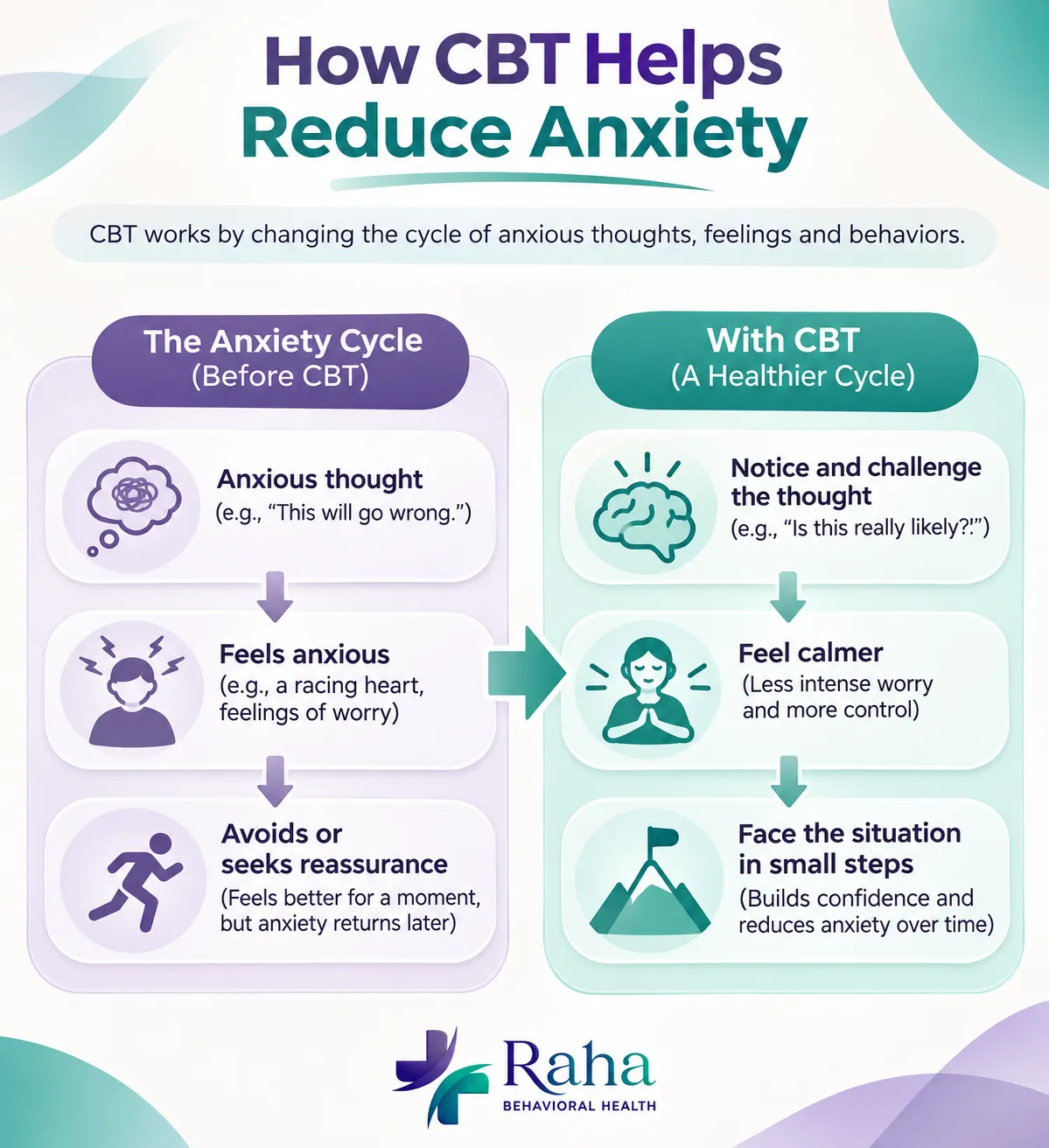
CBT works on the loop between what you think, how you feel and what you do.
Picture the loop. An anxious thought pops up (“this is going to go wrong”). Your body jumps in with a pounding heart or a tight stomach. So you do something to feel safer, like avoiding the thing, checking it again, over-preparing, asking someone to reassure you. It works for a minute. And then, quietly, it teaches your brain that the thing really was dangerous, so the anxiety comes back stronger next time.
In sessions, you learn to catch those anxious thoughts and test whether they hold up. You try different responses. You also work on behavior, slowly walking back into the things anxiety has taken from you. It’s skills based, which means you leave each session with something to practice.
That practice counts for a lot. People who do the exercises between sessions generally move faster than people who only show up. It’s a bit like physical therapy for your reactions. Nobody gets stronger from the appointment alone.
What is exposure therapy, and does it really work?
Exposure is the part of CBT where you face what you’ve been avoiding, in small steps, with support. It’s well studied, and it’s used for phobias, panic disorder, social anxiety, OCD, PTSD and generalized anxiety.
It sounds terrifying, and honestly that’s the main reason people hesitate. But the logic holds up. Avoiding something frightening feels better right away and makes the fear bigger over time. Exposure flips it. When you face the fear in a safe setting, your brain gets to learn that you can handle it, and that the feared outcome usually doesn’t show up. Reactions fade with repetition, and the link between the trigger and the “something terrible will happen” story weakens.
You don’t start at the top, by the way. You and your therapist make a list of the things you avoid and rank them from easy to hard. Then you start low. Exposure can happen in real life, in your imagination (vividly picturing a situation), or, for panic, by deliberately bringing on harmless body sensations like a racing heart until they stop feeling like a threat.
If your anxiety shows up mostly in your body, that last one matters. Physical symptoms of anxiety explains why the body reacts first, and panic attacks vs anxiety attacks walks through what’s going on during an attack.
Why does avoiding things make anxiety worse?
Because it feels like it works.
You skip the party, cancel the call, take the long way around. Relief, instantly. Your brain files that under “good call,” and the next time the same trigger shows up, the urge to avoid is stronger. Over weeks and months your world can shrink without you quite noticing, and the anxiety stays right where it was.
That’s the quiet engine behind a lot of anxiety. It’s also why so much of therapy points at it. You’re not being asked to feel nothing. You’re being asked to stop letting avoidance make the decisions. If you want to see how far this can spread, signs of an anxiety disorder lists the patterns, avoidance included.
What about acceptance and commitment therapy?
ACT takes a different angle. It doesn’t focus on arguing with anxious thoughts. It teaches you to notice them without letting them steer.
The idea is nonjudgmental acceptance of thoughts and feelings, plus getting involved in activities that matter to you, using things like mindfulness and goal setting. Research on how well it works for generalized anxiety is growing. Some people find it a relief after years of trying to think their way out of worry, because it stops being a fight.
Whether CBT or ACT suits you better often comes down to temperament. Many therapists blend the two. You don’t have to pick before you start.
Does EMDR help anxiety?
Not the way a lot of search results suggest.
EMDR is a structured therapy where you briefly focus on a trauma memory while following eye movements or another kind of back and forth stimulation. In the major American psychology guideline it’s suggested for PTSD, as a second choice behind trauma-focused CBT approaches. The guideline doesn’t say anything about everyday anxiety disorders.
So if your anxiety is tied to something traumatic, EMDR might come up. If it’s generalized worry, panic or social anxiety, CBT and exposure have the stronger support. For the trauma side, see trauma and PTSD treatment.
What daily habits actually help anxiety?
None of these cure anything. All of them can make the load lighter, and the better evidence points to a handful.
Movement comes first. Regular activity is a strong stress reducer, and the usual advice is something most days of the week. Walking, swimming, running, yoga, whatever you’ll actually do. If you haven’t moved in a while, start slow and build up. It may also help your sleep.
Caffeine can quietly work against you. Coffee, tea, cola and energy drinks make anxiety harder to control and can mess with sleep, so cutting back (or out) helps some people more than they’d guess.
Alcohol and nicotine deserve a careful look. Using alcohol or drugs to take the edge off tends to make anxiety worse over time, and nicotine can too. If cutting down is hard, bring it up with a provider.
Sleep and anxiety feed each other, which makes sleep worth protecting. Enough rest gives you more energy to cope with hard feelings. If you’re sleeping badly, mention it to a provider, and insomnia treatment is its own topic.
Food gets a lot of hype. Eating more vegetables, fruit, whole grains and fish may be linked to less anxiety, though researchers say more studies are needed. Don’t expect one food to fix it.
Relaxation tools like visualization, meditation and yoga can ease anxiety, and mindfulness and meditation may even help therapy work better. A hobby or a brisk walk can also pull your attention away when anxiety spikes.
One more note, about supplements. Some herbal products have been studied for anxiety, but the risks and benefits aren’t well understood, supplements aren’t regulated like medicines, and some can interact with prescriptions. Ask a doctor before trying any.
What breathing exercise helps with anxiety?
Slow belly breathing is the one most often recommended, and it takes five minutes.
Get comfortable, sitting or lying down, and loosen anything tight around your middle. Breathe in gently through your nose and let the breath drop deep into your belly, as far as feels comfortable without forcing it. Breathe out through your mouth. Keep it slow and steady. Counting from one to five on each breath can help, though you may not make it to five at first. Keep going for at least five minutes.
It’s described as a calming technique for stress, anxiety and panic, and it works best when you practice regularly, not only when you’re panicking. Do it on an ordinary Tuesday and it’s much easier to reach for on a bad day. It’s a skill, not a cure, and a good one to learn alongside therapy.
Can self-help books, apps and courses replace therapy?
Sometimes, for mild anxiety, they’re a decent start. They can’t replace therapy when anxiety is bigger.
Self-help books, online tools and courses you work through on your own are recommended as part of care in some health systems, including for generalized anxiety. They teach the same kind of CBT skills. The catch is that you’re doing it solo, with nobody to adjust the approach when you get stuck. Support groups can help too, though advice from other members should be taken carefully, and it doesn’t replace what a provider recommends.
If you’ve tried the self-help route for a couple of months and it isn’t making enough difference, that’s a signal to bring in a professional. It isn’t a sign you did it wrong.
How long does anxiety treatment without medication take?
There’s no single answer. For CBT, a typical course runs somewhere between about 5 and 15 sessions, sometimes more, and a lot depends on how long the anxiety has been around, how strong it is, and what else is going on in your life.
Small changes tend to come first. Falling asleep a bit faster, catching a worry spiral earlier, bouncing back quicker after a bad day. The bigger shifts usually arrive once you start using the skills between sessions, out in real life. Skills take practice, and early weeks are often about learning your own patterns.
For a closer look at timing, how long anxiety treatment takes goes through it in detail.
How do you put the non-medication tools together?
You don’t need all of them at once. Pick a couple and let them support each other.
A common mix looks like this. Therapy is the core, maybe weekly at first. Between sessions you do the exercises your therapist gives you. A few minutes of breathing each day builds the habit. Regular movement, a steadier sleep schedule and less caffeine lower the background hum so therapy has an easier time. And if stress is a big part of your life, stress management therapy and the stress management guide add tools for the stress side.
Start small. Layering six new habits in a week is a recipe for dropping all of them.
How do you know if non-medication treatment is working?
By small, steady changes, mostly.
You might sleep a little better, worry a little less, or recover faster after a rough day. You start doing something you used to avoid. A situation that used to flatten you shrinks. Friends or family may notice before you do.
It’s slower than most people want. Still, if you’ve given it a fair run and you’re not improving, tell your provider. They might change the approach, add something new, or talk with you about whether medication belongs in the mix. That’s a decision you make together, and nobody should change or stop any medicine they already take without checking with a provider first.
When should you talk to a professional?
When anxiety is getting in the way of school, work, sleep or your relationships. That’s the line. You don’t have to wait for panic attacks or a crisis.
Some clues: you’re avoiding things you’d otherwise do, worry is hard to switch off most days, your body is tense or run down from it, or you’ve started leaning on alcohol or other things to cope. Anxiety disorder types, symptoms and treatment covers the different kinds. If yours looks closer to a specific type, there are pages on generalized anxiety disorder, social anxiety and postpartum anxiety. And if you’re not sure whether it’s anxiety or low mood, depression vs anxiety can help you sort it out.
If you or someone you know is struggling or having thoughts of suicide, call or text 988 any time. In a life-threatening situation, call 911.
Frequently asked questions
Can anxiety be treated without medication?
Yes. Therapy, especially CBT, is a main treatment, and many people use it as their first step. Daily habits like exercise, sleep and cutting caffeine support it. If therapy isn’t enough, a provider can talk with you about other options.
What is the best natural treatment for anxiety?
There isn’t a natural fix that replaces treatment. Exercise, sleep, less caffeine, breathing and mindfulness help, and they’re worth doing. For anxiety disorders, CBT is considered the most effective form of therapy.
Does exercise help anxiety?
Yes. Regular activity is a strong stress reducer and may improve mood and sleep. Walking, swimming, running or yoga most days of the week is the usual advice. Start slowly and build up.
Can you cure anxiety without medication?
Treatment usually aims to bring symptoms down to a manageable level, not erase all anxiety, since everyone feels it sometimes. Many people improve a great deal with therapy. A provider can help you work out what progress should look like for you.
Can you treat panic attacks without medication?
Yes. CBT with exposure, including exposure to the body sensations of panic, is a common approach, and practicing slow breathing can help you ride out an attack. If panic keeps coming back, bring it to a provider.
Is EMDR good for anxiety?
EMDR is suggested for PTSD, not for everyday anxiety disorders. For generalized worry, panic or social anxiety, CBT and exposure have stronger support. If your anxiety is linked to trauma, ask a provider whether EMDR fits.
What breathing technique is best for anxiety?
Slow belly breathing is a simple, widely recommended one. Breathe in through your nose so it fills your belly, out through your mouth, counting to five, for at least five minutes. Practice it daily so it’s easier to use during a spike.
When do you need medication for anxiety?
There’s no single rule. It depends on your type of anxiety, how strong it is, your health and your preferences, and it can take some trial and error. If symptoms stay heavy despite therapy, or they make therapy hard to start, it’s reasonable to discuss medication with a provider.
Starting anxiety treatment at Raha Behavioral Health
If you’d like to work on anxiety without leaning on medication, therapy is the place to start, and our anxiety treatment in Houston page explains what’s available. That includes cognitive behavioral therapy, exposure-based approaches for facing feared situations step by step, and help building coping skills. Telehealth is available for eligible patients, so ask about it when you call.
If you want to talk through whether medication might ever fit, medication management is there as an option, and it’s your call.
You can meet our providers or contact us to get started.
This article is for general informational purposes only and does not constitute medical advice or a diagnosis. Anxiety can only be accurately assessed and treated by a licensed mental health professional.
Sources
- National Institute of Mental Health. Generalized Anxiety Disorder: When Worry Gets Out of Control
- Mayo Clinic. Anxiety disorders: Diagnosis and treatment
- NHS. Generalised anxiety disorder in adults: Treatment
- NHS. Generalised anxiety disorder in adults: Self-help
- NHS. Cognitive behavioural therapy (CBT): Overview
- NHS. Breathing exercises for stress
- American Psychological Association. Understanding psychotherapy and how it works
- American Psychological Association. Exposure therapy
- American Psychological Association. Eye movement desensitization and reprocessing (EMDR) therapy