

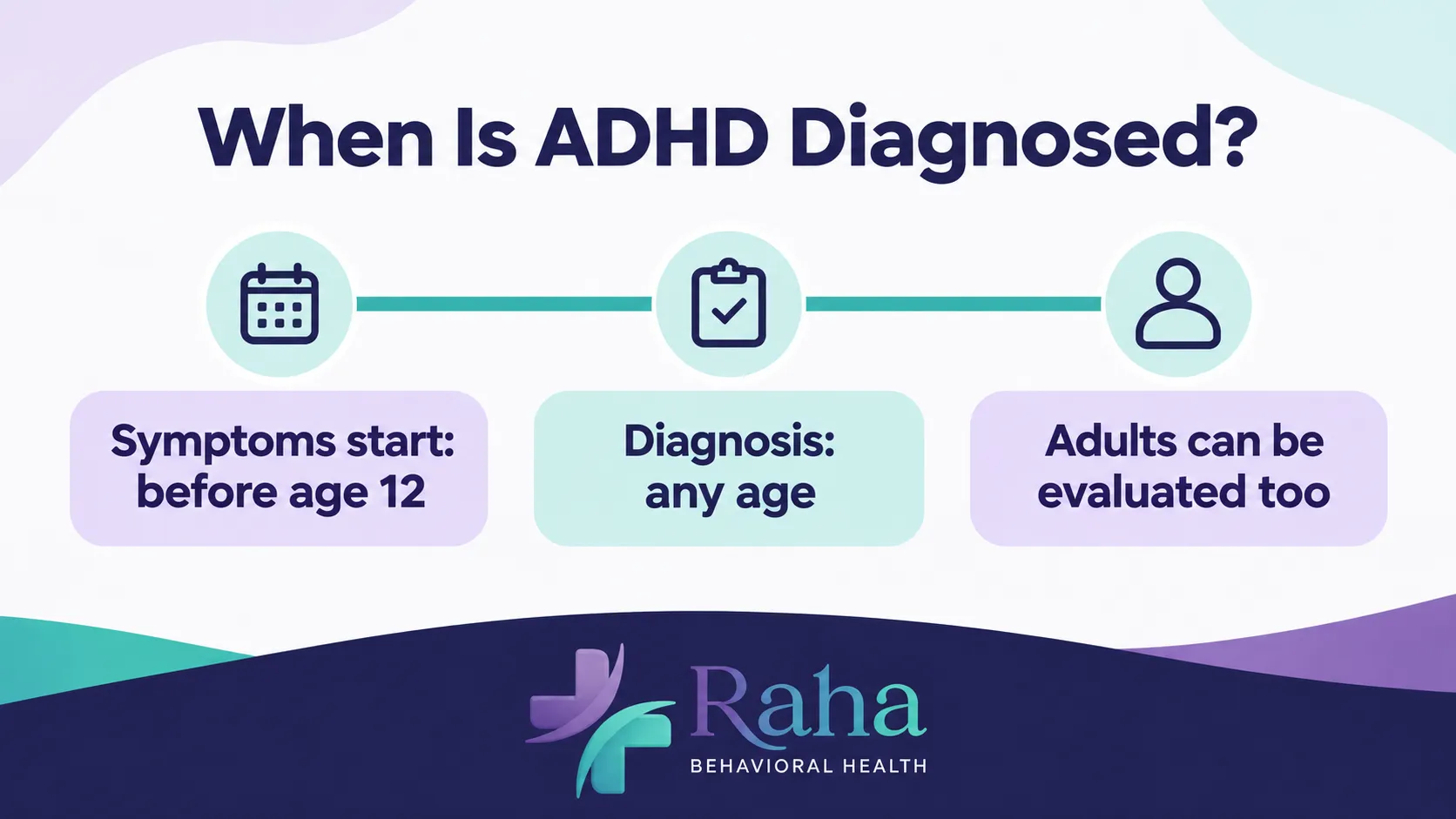
ADHD can be diagnosed at almost any age. The symptoms have to start in childhood, usually before age 12 and sometimes as early as age 3, but the diagnosis itself can come in elementary school, in the teen years or well into adulthood. Many people are diagnosed as children. Plenty of others are not diagnosed until adulthood.
So the real answer has two parts. When do symptoms have to begin? Before age 12. When can you be diagnosed? Whenever you get a full evaluation and meet the criteria. If you are an adult wondering whether it is too late, it is not.
This guide covers the age rules, the criteria a provider uses, why ADHD gets missed for years, how late diagnosis works and what to do if you think you have it.
At what age is ADHD usually diagnosed?
There is no single age. ADHD is one of the most commonly diagnosed childhood disorders, and symptoms usually start in early childhood. In the United States, an estimated 7 million children ages 3 to 17, about 11.7 percent, have a current ADHD diagnosis.
Symptoms usually begin before age 12, and some children show them as early as age 3. Even so, a child can go for years without a diagnosis. Some are noticed when schoolwork gets harder. Others are noticed when they hit the teen years and the demands on planning and self management go up. And some are not diagnosed until adulthood.
Here is how it tends to look at different ages.
| Stage of life | What the signs often look like | What diagnosis involves |
|---|---|---|
| Preschool | Short attention span and high energy, which are typical at this age | Providers look for patterns that go beyond normal development |
| School age | Trouble finishing tasks, losing things, fidgeting, talking a lot, trouble taking turns | Parents, teachers and other caregivers describe behavior at home, school and with friends |
| Teens | Attention often depends on how interested the teen is in a task | Same process, with the teen’s own account added |
| Adults | Disorganization, poor time management, restlessness, trouble finishing tasks | Providers rely on your past reports, interviews and rating scales |
What are the criteria for an ADHD diagnosis?
A provider looks at four main things.
- Symptoms in one or more of three areas. Inattention means trouble focusing, staying on task or staying organized. Hyperactivity means excess movement, restlessness or talking a lot. Impulsivity means interrupting others, acting without thinking or having trouble waiting turns.
- A set number of symptoms. Adults and teens over 16 need five symptoms. Children need six.
- Symptoms that started before age 12. ADHD is a developmental condition, so there has to be a childhood history, even if no one noticed it then.
- Problems in more than one setting. The behaviors must be frequent, show up in multiple settings, such as home and school or home and work, and interfere with daily life.
There are also three presentations. Some people mainly have inattention, some mainly have hyperactivity and impulsivity, and some have symptoms in all three areas. Symptoms can change over time, so the presentation may change as well. ADHD does not simply fade as a child grows up.
Can you be diagnosed with ADHD as an adult?
Yes. Some people are not diagnosed until adulthood, and many adults do not realize they have it.
The catch is the childhood rule. Because symptoms must have started before age 12, an adult evaluation has to look back. Providers rely heavily on past reports. They may:
- Talk with people who know you well, such as family, friends or a partner
- Look at school reports or other childhood records
- Use interviews, symptom checklists or rating scales
- Give psychological tests that look at memory, planning and reasoning
- Review your mood and medical history to rule out other conditions
You do not need a childhood diagnosis. You do need symptoms that began early and that cause real problems now. If you want the step by step version of this process, how to get tested for ADHD as an adult goes through it in order, and what happens during an ADHD evaluation describes the appointment itself.
Is it too late to get tested for ADHD?
No. The criteria do not set an upper age limit. The question is whether you had symptoms in childhood and whether you have ongoing problems now.
Symptoms can continue into adulthood, though hyperactivity often decreases with age while impulsiveness, restlessness and attention problems may remain. That is why an adult with ADHD may not look like the child people picture.
If you are somewhere in the middle of your life and think this might be you, signs of ADHD in adults is a good place to read first.
Why is ADHD diagnosed late?
Several things can hide it.
Symptoms can be mild. ADHD can be mild, moderate or severe. A person with milder symptoms may get by for years before the demands of life catch up.
It can look different from what people expect. Boys tend to show more hyperactivity, while girls may quietly lose focus. ADHD testing for women explains why women are so often missed.
Good grades can cover it up. A student who does well can go unnoticed. Can you have ADHD if you did well in school covers that in detail.
Other conditions get blamed first. Anxiety, depression, sleep disorders and certain learning disabilities can have symptoms similar to ADHD, and they often occur alongside it. A person may be treated for anxiety or low mood for years without anyone looking at attention. Depression vs anxiety helps sort out how those overlap.
People do not realize it is ADHD. Many adults do not realize they have it. They put the trouble down to laziness, a messy personality or not trying hard enough.
What are the signs that you may have been missed?
Think about whether any of these have been true for as long as you can remember.
- You lose things all the time, or forget parts of your daily routine.
- You start many tasks and finish few.
- Time gets away from you, and you are often late. Why ADHD makes time so hard to track describes this.
- You get easily distracted, even by your own thoughts.
- You feel restless, or you have to keep moving.
- You act or speak before you think.
- Small frustrations feel big, or your temper is quick. ADHD and reactions to criticism covers one common version of this.
- You struggle to sleep. ADHD and sleep problems explains the connection.
- You feel overwhelmed by ordinary demands, like paperwork, chores or emails. Mental overload goes into how that builds.
One or two of these is normal for anyone. A long pattern that began early and shows up in more than one part of your life is what a provider looks for.
What is the difference between diagnosing a child and diagnosing an adult?
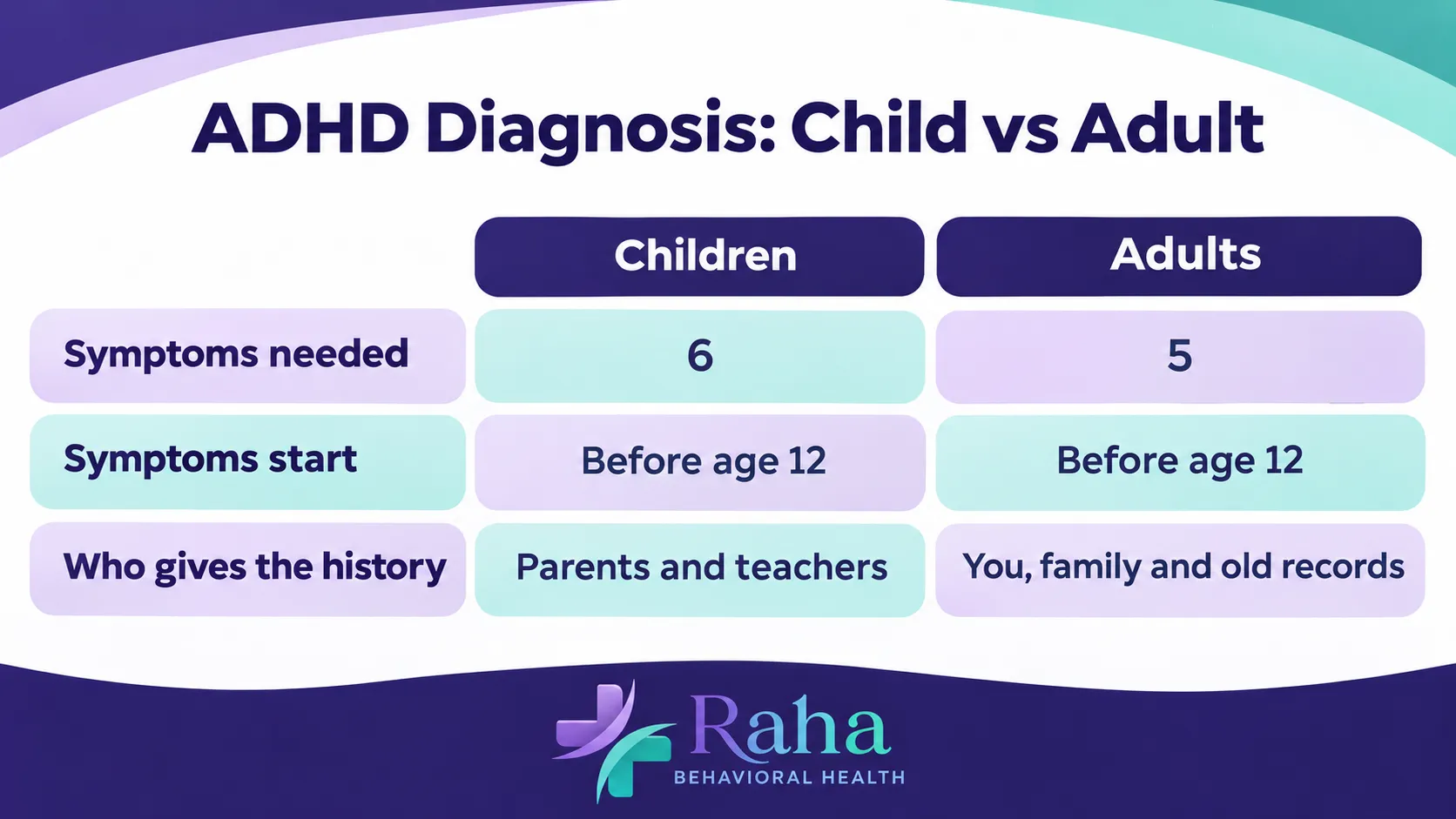
The main difference is who provides the information.
For a child, providers ask parents, teachers and other caregivers about behavior at home, at school and with friends. A medical exam, including hearing and vision tests, helps rule out other causes.
For an adult, you are the main source. The childhood history comes from your own memory, plus reports and people you can bring in. The medical history and mood history matter too, because other conditions can look like ADHD.
The numbers differ, too. Adults need five symptoms and children need six. In both cases, the symptoms must have started before age 12 and must cause problems in more than one setting.
Can ADHD start in adulthood?
ADHD is a neurodevelopmental condition, and its symptoms begin in childhood. A person who seems to develop attention problems for the first time as an adult is a different situation, and a provider will look at other possible causes.
Those can include sleep disorders, anxiety, depression, certain learning disabilities, and hearing or vision problems. A full evaluation includes a look at your medical history and mood history for exactly this reason.
It also helps to dig into the past. Symptoms that seem new may have been there in milder form in childhood.
Is there a right age to test a child for ADHD?
Symptoms can start as early as age 3, but young children are naturally active and have short attention spans. Preschoolers commonly have both, and that is typical development, not ADHD.
That is why a child should not be diagnosed just for differing from peers or siblings. Providers look for symptoms that are more frequent and more intense than usual for the child’s age, that show up in more than one setting and that get in the way of daily life. Problems at school alone, without trouble at home or with friends, may point to a different concern.
If you suspect ADHD in a child, start with the child’s regular healthcare provider, who can check for other causes and refer to a specialist if needed.
Can you have ADHD without being hyperactive?
Yes, and this is one of the biggest reasons ADHD gets diagnosed late. There are three presentations, and only one of them is built around hyperactivity.
- Predominantly inattentive. Trouble organizing or finishing tasks, paying attention to details, or following instructions and conversations. The person is easily distracted and may forget parts of the daily routine. There is little or no fidgeting.
- Predominantly hyperactive and impulsive. Fidgeting, excessive talking and trouble sitting still. The person may interrupt others, speak at the wrong time or have trouble waiting a turn.
- Combined. Both sets of symptoms are present about equally.
A person with the inattentive presentation can sit quietly in class and still be far behind. Because nothing disrupts the room, no one flags it. Many people are not diagnosed until they reach adulthood, when the work stops being something a teacher can structure for them.
Do ADHD symptoms change from childhood to adulthood?
They can. Symptoms that start in childhood may continue into adulthood, though they often look different. ADHD symptoms do not simply fade as children grow up, and the presentation can shift over time.
The most common change is that hyperactivity often decreases with age. A child who ran, climbed and could not sit still may grow into an adult who feels restless inside, fidgets or cannot relax. Impulsiveness, restlessness and attention problems may stay. So an adult may see less of the physical side and more of the mental one: a mind that jumps, a to do list that never shrinks, a habit of starting more than can be finished.
That shift is part of why adults often do not connect their own struggles to a childhood label. If you were a quiet kid who got by, or an energetic one who settled down, your adult symptoms may look nothing like what you remember.
Who can diagnose ADHD?
A trained clinician makes the diagnosis after a full evaluation. There is no single test. A diagnosis is a multi step process that includes a medical exam, a look at your history and symptoms, and a review of other conditions that might explain what you are seeing.
For adults, look for a provider with training and experience in treating adults with ADHD. Raha’s page on ADHD testing describes the service, and ADHD screening tools explained shows how short questionnaires differ from a full evaluation. If you are nervous about the results, can you fail an ADHD evaluation addresses that worry.
What happens after you are diagnosed late?
For many adults, a late diagnosis brings relief. It gives a name to patterns that have been there for years. After that comes a conversation about treatment.
Medication. For adults, ADHD medication is usually a stimulant. It can take some trial to find what works, and your provider will adjust over time. Medication management is where follow up visits happen, and what is medication management and how does it work explains how that works.
Therapy. Cognitive behavioral therapy and other behavioral therapy build practical skills for planning, time and follow through. Cognitive behavioral therapy is one common option.
Other supports. Some adults use an ADHD or life coach to build skills for planning and organization, and regular exercise helps.
Treatment often combines approaches, and many people need to try several before finding what works. If you are deciding between options, medication or therapy compares them, and what happens after an ADHD diagnosis covers the first weeks.
Adults whose symptoms affect their work may also qualify for workplace accommodations, so a diagnosis can matter beyond treatment. Adult ADHD is also linked with poorer job performance and financial problems, and with a higher likelihood of risky behaviors, which is a reason to get answers.
What should you do if you think you have ADHD?
You can take these steps in order.
- Write down what you notice. Use real examples of when and where it happens.
- Think back to childhood. Report cards, teacher comments or family memories help, since adult ADHD depends on symptoms that started before age 12.
- Ask someone who knows you well. A parent, partner or close friend often sees patterns you miss.
- Note other factors. Sleep, caffeine, alcohol, stress and mood all affect focus.
- Book an evaluation with a provider who works with adults. Describe your history, and bring what you collected.
If you are also dealing with low mood, anxiety or poor sleep, say so at the visit. Those can sit alongside ADHD, and they matter for the plan. Anxiety treatment, depression treatment and insomnia treatment are all part of the same picture for many people. For a general guide on when to look for help, see when should you seek professional mental health care.
If you are thinking about harming yourself, call or text 988. If you are in immediate danger, call 911.
Quick answers about when ADHD is diagnosed
At what age is ADHD diagnosed?
There is no single age. Symptoms usually start before age 12, and some children show them as early as age 3. A diagnosis can come in childhood, the teen years or adulthood.
Can you be diagnosed with ADHD at 30?
Yes. Adults are diagnosed at every age. The evaluation checks for symptoms that started before age 12 and that cause problems now, using your history, interviews and rating scales.
Can you get diagnosed with ADHD at 40 or later?
Yes. Nothing in the criteria sets an upper age limit. What matters is a childhood history of symptoms and ongoing problems in your current life.
Is it too late to get tested for ADHD?
No. If you think you have symptoms that began in childhood and still cause problems, an evaluation can still help, no matter how old you are.
What is the age rule for ADHD?
Symptoms must have started before age 12 for an adult to meet the criteria. This is about when symptoms began, not when you are diagnosed.
How many symptoms do you need to be diagnosed with ADHD?
Adults and teens over 16 need five symptoms. Children need six. The symptoms must be frequent, show up in more than one setting and interfere with daily life.
Can ADHD be diagnosed without childhood records?
Yes. Providers rely on past reports, but those can come from people who knew you, like a parent or sibling, as well as school records. If none are available, a provider will use what is.
Why was my ADHD missed as a child?
Symptoms can be mild, quiet or hidden by good grades. Girls may quietly lose focus instead of showing hyperactivity, and other conditions like anxiety can be blamed first.
Can ADHD appear suddenly in adulthood?
ADHD symptoms begin in childhood. Attention problems that seem to start in adulthood can have other causes, such as sleep problems, anxiety, depression or a medical condition, so an evaluation looks at those too.
Does ADHD go away as you get older?
Not always. Hyperactivity often decreases with age, while impulsiveness, restlessness and attention problems may remain. Symptoms can change over time, and the presentation may change too.
Who can diagnose ADHD in adults?
A trained clinician, after a full evaluation. Look for someone with training and experience in treating adults with ADHD.
Can a child be tested at age 3?
Symptoms can show up that early, but short attention spans and high energy are typical in young children. A provider looks for patterns that go beyond typical behavior, so the child’s regular healthcare provider is the place to start.
Get ADHD Testing and Treatment at Raha Behavioral Health in Houston
If you have wondered for years whether ADHD explains your struggles, you can start now. Raha Behavioral Health offers ADHD testing in Houston, along with medication management and cognitive behavioral therapy for treatment afterward.
You can also read about adults and children in ADHD testing, meet the providers, contact the office or request an appointment.
Sources
- Attention-Deficit/Hyperactivity Disorder (ADHD) – National Institute of Mental Health
- ADHD in Adults: 4 Things to Know – National Institute of Mental Health
- Diagnosing ADHD – Attention-Deficit / Hyperactivity Disorder (ADHD) – CDC
- Symptoms of ADHD – Attention-Deficit / Hyperactivity Disorder (ADHD) – CDC
- Data on ADHD in Children – Attention-Deficit / Hyperactivity Disorder (ADHD) – CDC
- Attention-deficit/hyperactivity disorder (ADHD) in children – Symptoms and causes – Mayo Clinic
- Adult attention-deficit/hyperactivity disorder (ADHD) – Symptoms and causes – Mayo Clinic
This article is for general information only and is not a diagnosis or medical advice. ADHD can only be diagnosed by a licensed healthcare provider after an evaluation. If you are thinking about harming yourself, call or text 988. In an emergency, call 911.