

There isn’t one “best” ADHD test, because no single test can diagnose ADHD. What exists is a toolkit. A short screener asks whether it’s worth looking closer. Rating scales collect symptoms from you and the people around you. An interview goes through your history in detail. Sometimes a clinician adds psychological or computer-based testing. The tools you’ll meet most often are the ASRS for adults, the CAARS 2 for adults, the Conners 4 for children and teens, and the Vanderbilt scales for school-age kids.
None of them diagnoses ADHD on its own. Each one adds a piece, and a clinician puts the pieces together. This post goes through each tool, what it asks, who it’s for, and what a result can and can’t tell you.
What kinds of ADHD tests are there?
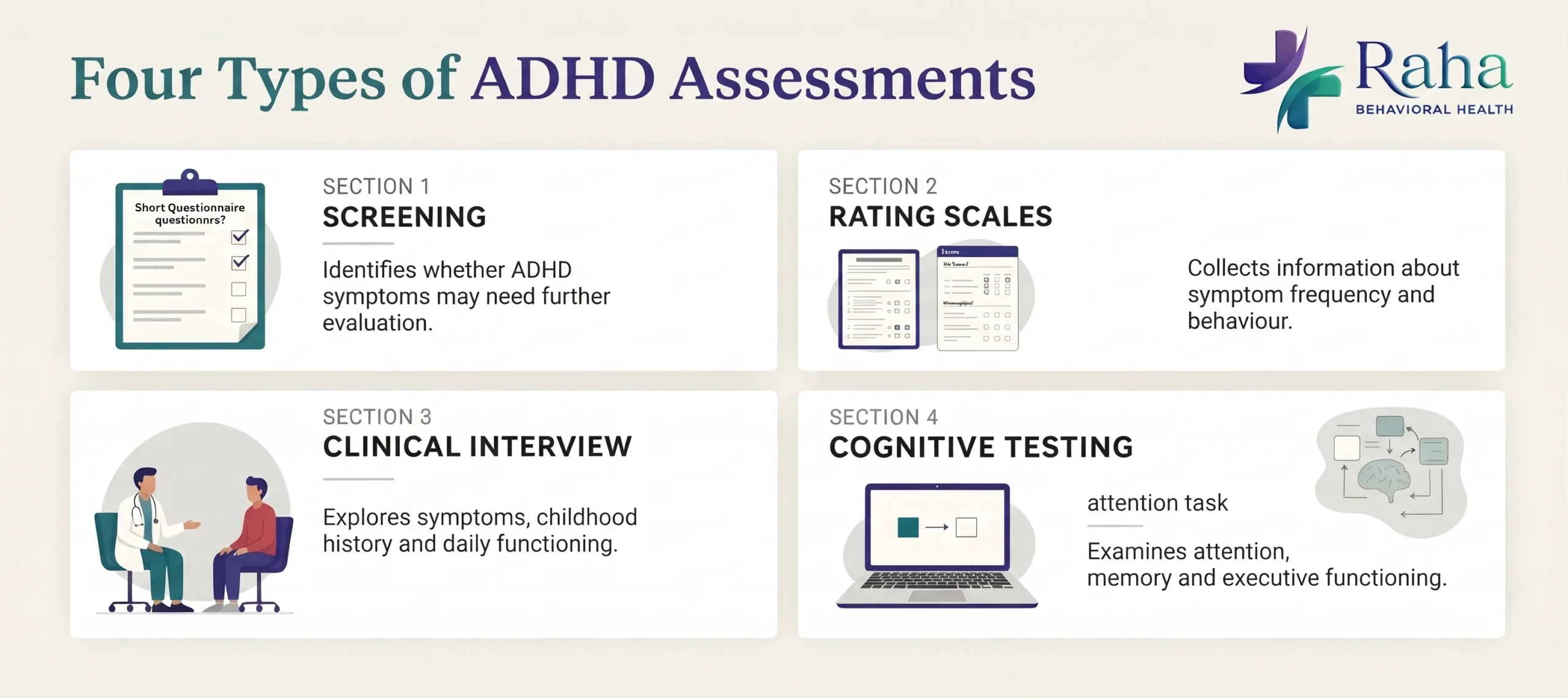
Four kinds, and it helps to keep them apart, because people lump them all under “the ADHD test.”
The first kind is a screener. It’s short, usually a few minutes, and it answers one question: do your symptoms look similar enough to ADHD that a full evaluation makes sense? A screener can’t confirm anything. The ASRS six question form is the best known.
The second kind is a rating scale. These are longer questionnaires that ask how often you (or your child) show specific behaviors, like losing things, interrupting, or leaving tasks half done. Many have one version for the person and another for a parent, teacher, partner or friend. The CAARS 2, the Conners 4 and the Vanderbilt scales all belong here.
The third is a clinical interview. A trained clinician asks about symptoms now and in childhood, how long they’ve lasted, where they show up, and how much they’ve gotten in your way. Some interviews follow a fixed script, like the DIVA-5 for adults. Most evaluations also include a looser conversation about your history, health, mood, sleep and family.
The fourth is testing of thinking skills. Psychological tests can look at memory, planning and reasoning. Some clinics also use computer-based attention tasks to see how a person performs on a set of timed exercises. These aren’t needed for everyone.
Alongside all of that, a provider reviews your medical and mood history to rule out other explanations. There’s no blood test or brain scan that diagnoses ADHD.
What are these tools actually checking for?
Every tool on this page is built around the same list. It comes from the diagnostic manual, the DSM-5-TR, and it’s what a clinician uses at the end to decide whether ADHD fits.
The list has two groups of symptoms. One is inattention, like missing details, losing things, trouble staying on a task, and forgetting. The other is hyperactivity and impulsivity, like fidgeting, restlessness, talking over people and acting before thinking. You can have mostly one, or both.
How many symptoms you need depends on age. Children up to 16 need six from a group. From age 17 on, including adults, it’s five.
The symptoms also have to meet a few other rules. They’ve lasted at least six months. They’re stronger than what’s expected for your age. Several started before age 12. They show up in more than one setting, like home and school or home and work. They clearly get in the way of daily life. And another condition doesn’t explain them better.
A screener or rating scale mostly covers the first part, the symptom count. The rest, like when it started, where it shows up and what else could be behind it, comes from the interview and your history. That split is why a form on its own can’t finish the job.
What is the ASRS, and how does it work?
ASRS stands for Adult ADHD Self-Report Scale. It’s for adults 18 and older, and it was developed with the World Health Organization by a group of researchers and clinicians, including Dr. Ronald Kessler at Harvard Medical School. It comes in two lengths.
The long one is an 18 question symptom checklist. The short one is a six question screener pulled from that longer checklist.
You answer based on how you’ve felt and acted over the past six months. Each answer is on a five step scale: Never, Rarely, Sometimes, Often, Very Often.
The six screener questions ask about trouble wrapping up the last details of a project once the hard parts are done, trouble getting organized when a task needs organizing, forgetting appointments or obligations, putting off tasks that need a lot of thought, fidgeting or squirming when you have to sit for a long time, and feeling overly active, like you’re driven by a motor.
Scoring works by shading. The answer boxes on the form are shaded in places, and you count the checkmarks that land in the shaded area. Four or more means your symptoms may be consistent with adult ADHD and that it’s worth talking to a healthcare provider about an evaluation.
That’s all it means. The form itself says it’s a starting point and not a diagnosis. A low score doesn’t clear you either, and the form advises talking with a provider about concerns regardless of the score.
There’s also a practical point. The ASRS is copyrighted, and reproducing or changing it needs permission. If an online version gives its own scoring and a flat “You have ADHD” result, treat it with caution. The original, or a version handed to you in a clinician’s office, is the safer bet.
Is the “WHO ADHD test” the same as the ASRS?
Yes, in almost every case. When people search “who adhd test,” they usually mean the ASRS, since it was developed with the World Health Organization. They aren’t talking about a test that WHO sells or runs. It’s a free questionnaire that clinicians and researchers use around the world.
If a site claims to offer a “WHO ADHD test” with a different set of questions, check where it came from. The real ASRS has the six or eighteen questions described above.
What does a high screening score mean, and what doesn’t it?
A high score means “this looks worth checking.” It doesn’t mean ADHD.
Lots of things can push your answers up. Anxiety can make you restless and scattered. Depression can make it hard to start and finish things. A rough sleep stretch makes anyone forgetful and fidgety. Stress at work, a new baby, grief, a medical condition, or certain medicines can do the same. A screener doesn’t ask why you’re having trouble. It only counts how often.
So a score should lead to a conversation and not a conclusion. If you want to go deeper on what quizzes can and can’t tell you, how accurate ADHD testing is covers it, including what a “failed” evaluation really means.
What is the CAARS 2?
CAARS 2 is the second edition of the Conners’ Adult ADHD Rating Scales. It’s built for adults 18 and older, and it covers core ADHD symptoms along with other concerns that often go with them.
The big feature is that it has two viewpoints. The self-report form is filled out by you. The observer form is filled out by someone who knows you, like a partner, family member or close friend. Putting those side by side can show where your view and theirs match, and where they don’t.
It comes in three sizes. The full version has 97 items and is typically used when a clinician wants full information, like at the start of an evaluation. A short version has 55 items on the self-report and 52 on the observer form. The ADHD Index has 12 items and works as a quick screen to decide who might need more.
It’s designed to aid the diagnostic process, treatment decisions and tracking over time, always alongside other information. It doesn’t replace a clinician’s judgment.
What are the Conners scales for children and teens?
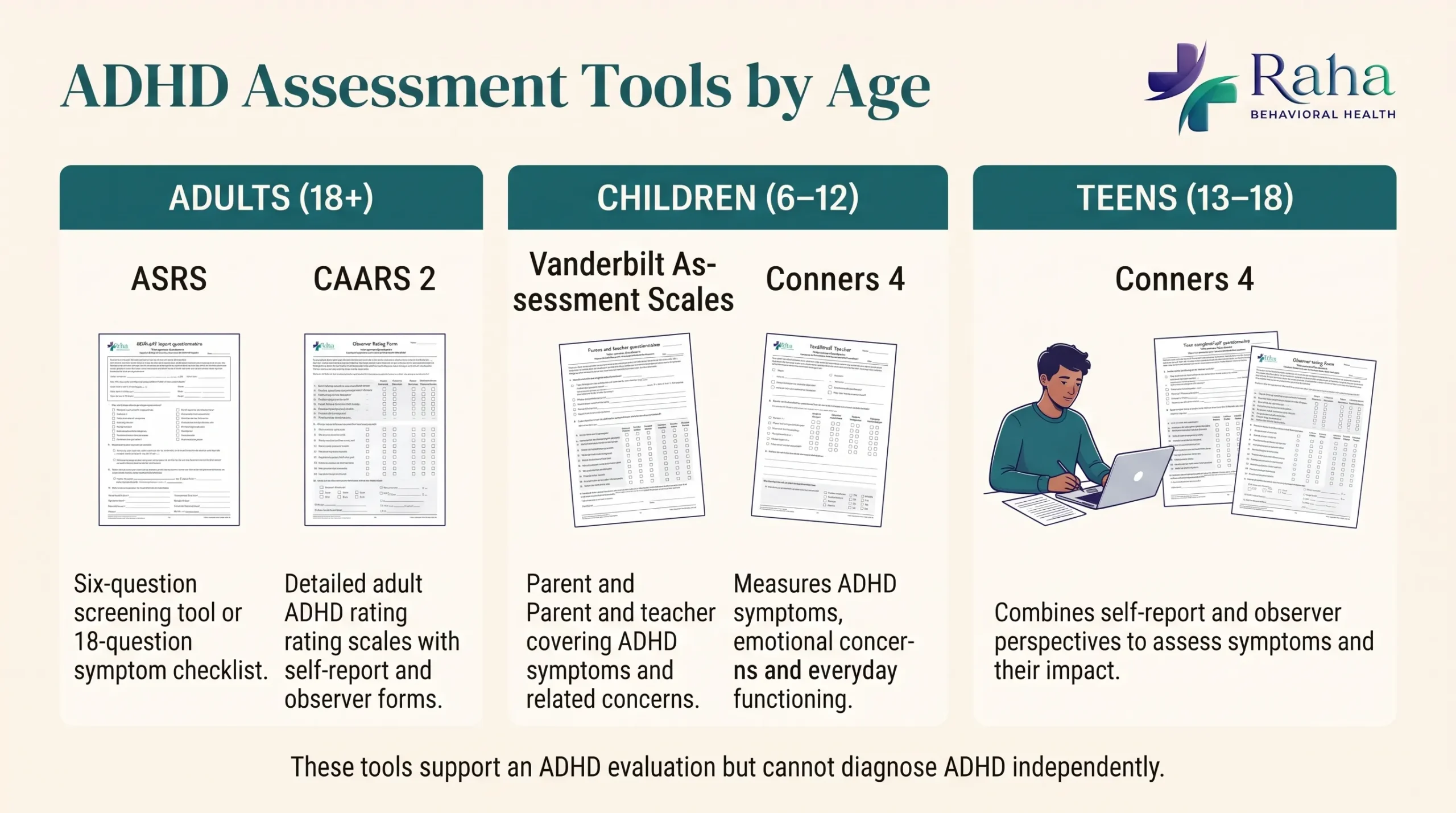
The current children’s version is the Conners 4. It covers ages 6 to 18. Parents and teachers can both fill it out for kids 6 to 18, and kids 8 to 18 can fill out a self-report form.
The Conners 4 measures more than the two core ADHD groups. Its scales include inattention and executive function trouble, hyperactivity, impulsivity, emotional dysregulation, depressed mood and anxious thoughts. It also asks how much the symptoms get in the way at school, with friends and at home. Some items flag sleep problems or other concerns that deserve a closer look.
Like the adult tools, it comes in more than one length. The full form takes around 12 to 15 minutes. The short form takes about 5 to 7. The 12 item ADHD Index takes a minute or two.
Results get compared with other children the same age and with a group of children who have ADHD, to judge how strong the symptoms are. Because the scales cover mood and anxiety too, a Conners 4 can hint that something besides ADHD is part of the picture.
How the whole process changes with age is covered in ADHD testing for adults vs. children.
What are the Vanderbilt scales?
The Vanderbilt Assessment Scales are free forms for children ages 6 to 12. There’s a parent version and a teacher version, which matters, because ADHD has to show up in more than one setting. Teachers see a different side of a child than parents do.
The first set of forms checks for the symptoms of both inattentive and hyperactive ADHD. It also looks for signs of related concerns: oppositional behavior, conduct problems, and anxiety or depression. A follow-up version later on tracks only the 18 core ADHD symptoms, which helps families and clinicians see whether things are changing over time.
They’re available in English and Spanish. They’re widely used because they’re easy to hand out and fill in.
Like everything else here, a Vanderbilt result is information. It’s not a verdict.
What is a structured interview like the DIVA-5?
The DIVA-5 is a semi-structured diagnostic interview for adults. “Semi-structured” means a clinician follows a set list of questions, but can follow up on your answers. It’s built on the diagnostic manual’s ADHD criteria.
It asks about symptoms in adulthood and in childhood, how long they’ve been going on, and how much trouble they’ve caused across your life. That childhood part matters, since an adult diagnosis requires that symptoms began before age 12. There’s also a version for ages 5 to 17.
You won’t always see the DIVA-5 by name. Many clinicians run their own interview that covers the same ground. What matters is that the conversation goes through each symptom with real examples, not just yes or no answers.
If you’re wondering how a visit works from start to finish, what happens during an ADHD evaluation lays out the steps.
What about computer-based attention tests and psychological testing?
Some evaluations add them. Others don’t.
Psychological testing looks at thinking skills, like memory, planning and reasoning. It can show strengths and challenges, and it can point to learning disabilities that might be part of the picture. A clinician may send you for it when the history is complicated or when learning problems seem likely.
Computer-based tests, often called continuous performance tests, ask you to respond to certain things on a screen and ignore others, over a set stretch of time. They can give extra information about how severe attention or impulse control problems are. They don’t diagnose ADHD by themselves. Doing well or badly on one task on one day can’t settle the question by itself.
Think of both of these as optional extras. Ask your provider whether either would add anything in your case.
Which ADHD test is best?
Honest answer: it depends on who’s being evaluated and why.
For an adult wondering whether to get evaluated, the ASRS screener is a decent first step. It’s quick, and it’s built for exactly this purpose. For a full adult evaluation, a rating scale like the CAARS 2, plus a good interview, gives a much richer picture.
For a school-age child, the Vanderbilt or the Conners 4, filled out by both a parent and a teacher, are the usual tools. Teens often get the Conners 4 with a self-report form added.
The best “test” is really the combination. A screener or rating scale gives numbers. An interview gives context and history. Information from people who know you (a partner, a parent, a teacher) fills in what you can’t see yourself. And a check for other conditions makes sure ADHD is the right answer.
If a clinic tells you a single quiz or a single computer task settled it, that’s worth questioning.
Why can rating scales be wrong?
They’re only as good as the answers that go in.
Self-report has limits. People who’ve spent years compensating, by overworking, over-planning or masking, may answer “sometimes” where an outsider would say “always.” Someone in a low or anxious stretch may rate everything worse than usual. And some people don’t notice their own habits until someone points them out.
Memory plays a part too. Adult evaluations ask about childhood, and few of us remember age nine clearly. So a parent’s or older sibling’s account, or an old report card, can add so much.
Rating scales also can’t tell you why. If someone scores high on inattention, the scale doesn’t know whether the cause is ADHD, anxiety, depression, poor sleep, trauma, a medical problem or something else. Conditions that can look like ADHD include learning disorders, mood disorders, anxiety, substance use, head injuries, thyroid conditions and some medicines. That sorting is the clinician’s job.
Our posts on ADHD and sleep and on doing well in school with ADHD show two places where the forms and the full story can disagree.
What should you do with your screening results?
Bring them with you. Don’t try to diagnose yourself from a number.
If you took an online screener, note the score and which questions you marked high. Better, write down two or three real moments from the past month that match those answers. Specific examples tell a clinician more than a score does.
If your child’s teacher filled out a form, ask for a copy to bring. If a partner or parent agreed to fill out an observer form, give them time to answer honestly. Short, specific answers beat polished ones.
And answer the forms the way things really are, not the way you wish they were, or the way they were on your best week. The tools only work when the answers are real.
If the evaluation points toward ADHD, treatment often includes talking therapy, medicine or both. Our posts on what happens after an ADHD diagnosis and on ADHD signs, symptoms and treatment explain what comes next. If you’re looking at yourself or someone else for the first time, ADHD testing for women covers how ADHD can look different and get missed.
Getting evaluated for ADHD at Raha Behavioral Health in Houston
Raha Behavioral Health does ADHD testing for adults, teens and children from the office on Westheimer Road in Houston, and by telehealth when it fits. Not every evaluation works well on video, and your clinician will tell you if yours should be in person.
An evaluation covers your current symptoms, your childhood and school history, and your work and home life. It also screens for things that can look like ADHD, like anxiety, depression, trauma and sleep problems. Our ADHD testing in Houston page explains what’s involved, and you can read about our providers first.
To book, contact us.
Frequently asked questions
Which ADHD test is the most accurate?
No single test is the most accurate, because ADHD is diagnosed from a full evaluation and not a score. Rating scales and structured interviews give the strongest information when they’re used together with your history and input from people who know you.
What is the ASRS test for ADHD?
The ASRS is the Adult ADHD Self-Report Scale, developed with the World Health Organization. It has an 18 question checklist and a six question screener. Four or more shaded answers on the screener suggest your symptoms may be consistent with adult ADHD and that an evaluation is worth having.
Can an online ADHD test diagnose me?
No. An online test can show that your answers look similar to ADHD, but only a clinical evaluation can diagnose it. Many online versions also change the original questions or scoring, so the result may not mean much.
What is the "WHO ADHD test"?
It usually means the ASRS, since that screener was developed with the World Health Organization. It’s a free questionnaire used by clinicians around the world. It isn’t a separate test run by the WHO.
What ADHD scales are used for children?
The Vanderbilt scales (ages 6 to 12) and the Conners 4 (ages 6 to 18) are two of the most common. Both use forms filled out by parents and teachers, since symptoms need to show up in more than one setting. The Conners 4 also has a self-report form for kids 8 and older.
Is there a blood test or brain scan for ADHD?
No. There are no specific blood tests or routine brain scans that diagnose ADHD. Doctors may order tests to rule out other causes of your symptoms, but the diagnosis comes from your history, your symptoms and rating scales.
How long does an ADHD rating scale take?
It depends on the form. The ASRS six question screener takes a few minutes. The Conners 4 full form takes about 12 to 15 minutes, and the short version about 5 to 7. The interview itself takes longer, and many evaluations include more than one visit.
What happens if my ADHD screening score is low?
A low score doesn’t rule out ADHD. If your symptoms are still getting in the way of work, school or relationships, bring it up with a provider. Other conditions can also cause these problems and are worth checking.
Disclaimer: This article is for general informational purposes only and does not constitute a diagnosis or medical advice. ADHD can only be accurately diagnosed through an evaluation with a licensed provider.
Sources
- Harvard Medical School, National Comorbidity Survey. Adult ADHD Self-Report Scale (ASRS-v1.1) and 6 question screener
- Kessler RC, et al. The World Health Organization Adult ADHD Self-Report Scale (ASRS). Psychological Medicine, 2005 (cited on the Harvard ASRS page)
- National Institute of Mental Health. Attention-Deficit/Hyperactivity Disorder: What You Need to Know
- Centers for Disease Control and Prevention. Diagnosing ADHD
- Centers for Disease Control and Prevention. Clinical Care of ADHD in Children
- American Psychiatric Association. What Is ADHD?
- Multi-Health Systems. CAARS 2: Conners Adult ADHD Rating Scales
- Pearson Clinical. Conners 4 overview
- University of Washington AIMS Center. NICHQ Vanderbilt Assessment Scales
- DIVA Foundation. What is DIVA-5?