

Many people feel some side effects in the first weeks of taking an antidepressant. The most common ones are nausea, headache, sleep changes, dry mouth, dizziness and sexual side effects. Most of these are mild, and many ease within the first few weeks. A few signs, such as new suicidal thoughts, a very high fever with confusion, or racing thoughts with unusual energy, need a call to a provider right away.
This guide covers which side effects are common, which tend to fade, which can stay and which ones to report. It also covers what to do when a side effect bothers you, and why stopping on your own is the one move to avoid. If you are still deciding whether medicine is right for you, our post on medication or therapy walks through that choice.
What are the most common antidepressant side effects?
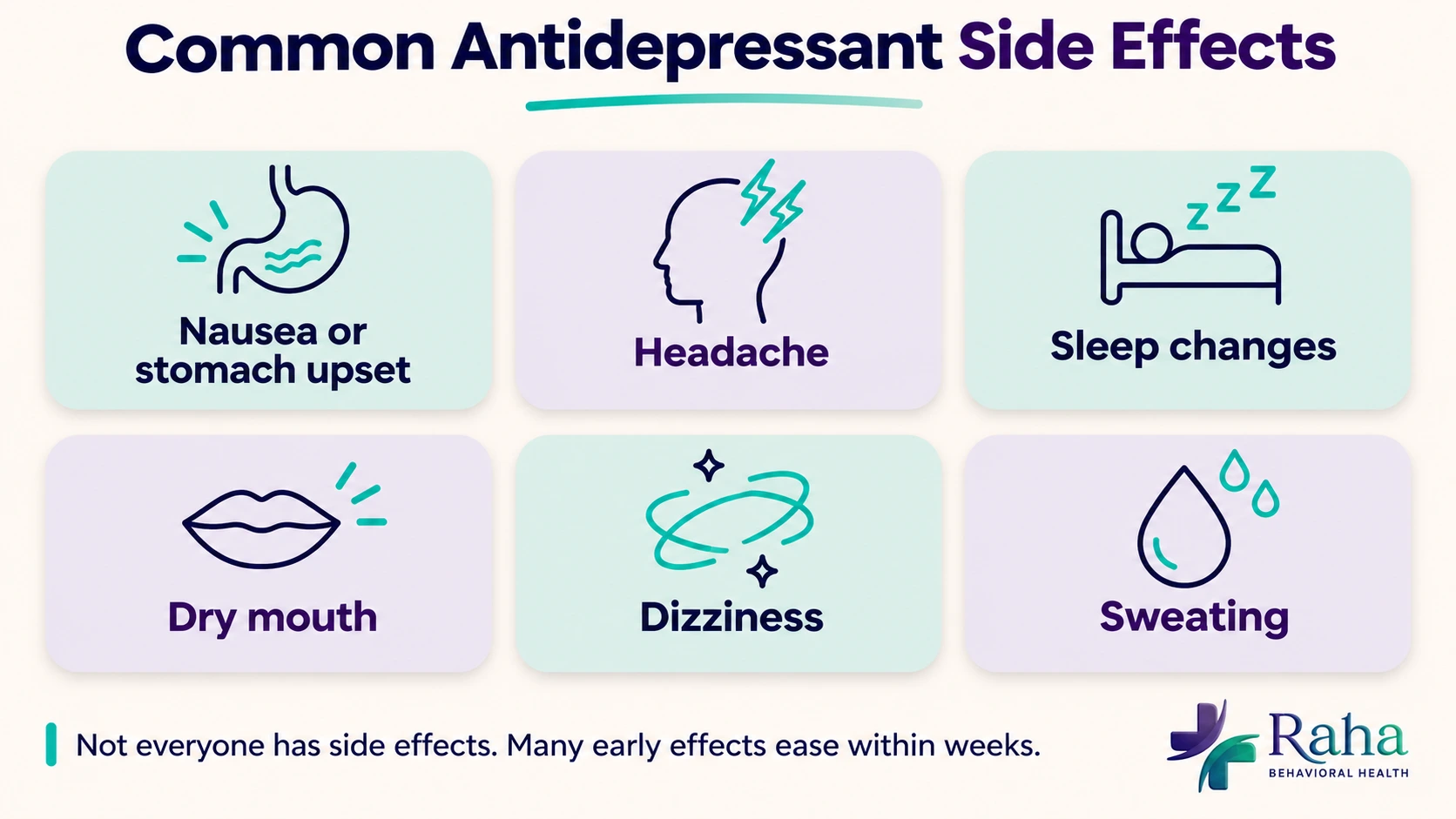
Not everyone has side effects. Some people notice almost nothing, and others notice several. The most common ones are:
- Nausea, stomach upset, vomiting or diarrhea
- Headache
- Sleepiness or trouble sleeping
- Dry mouth
- Dizziness
- Sweating more than usual
- Feeling nervous, restless or shaky
- Changes in appetite, with weight gain or weight loss
- Sexual problems, such as lower desire or trouble reaching orgasm
Some people also describe feeling irritable or emotionally flat. Others notice blurred vision, constipation or changes in how often they urinate. Any one person will have only a few of these, if any.
Which side effects tend to fade?
Many side effects are strongest in the first days and weeks and then settle as your body adjusts. Nausea and sleep problems are the two that most often improve within the first few weeks. Headache, dizziness and an unsettled stomach follow the same pattern for many people.
That is why the first month can feel like the hardest stretch. You may feel the side effects before you feel any benefit, and that is a normal part of starting treatment. The next section explains why.
How long do antidepressant side effects last?
There is no single answer, because each person and each medicine behaves differently. A rough guide:
| Side effect | What often happens |
|---|---|
| Nausea and stomach upset | Often eases within the first few weeks |
| Sleep changes (drowsy or wired) | Often improves within the first few weeks |
| Headache and dizziness | Often settles as the body adjusts |
| Restlessness, jitteriness, anxiety | Commonly appears early and may fade; tell your provider if it is strong |
| Dry mouth and sweating | May ease, but can continue for some people |
| Weight and appetite changes | May build over time rather than fade |
| Sexual side effects | May continue for as long as you take the medicine, and for some people after stopping |
Think of this table as a general pattern, not a promise. If a side effect is still there after several weeks, or it is hard to live with, tell your provider. There are usually things to try, and you do not have to wait it out alone.
Why do antidepressants cause side effects at all?
Antidepressants change how chemical messengers in the brain work. Those messengers also play a part in the gut, in sleep and in other body systems, so changes can show up outside your mood. That is why a medicine for depression can cause nausea or affect sleep.
Different types of antidepressants act on different messengers. SSRIs, for example, are the most commonly prescribed type, and they are more likely than some others to cause sexual side effects. Other types have their own patterns. This is one reason a provider may suggest switching to a different medicine if the first one does not suit you.
Will side effects show up before the medicine starts to work?
Often, yes. Antidepressants usually take 4 to 8 weeks to work fully. Sleep, appetite, energy and concentration often improve before mood does. So early side effects and early relief can overlap, and the medicine may be doing its job even while you feel uncomfortable.
This is also why the first weeks matter. You are watching for two things at once: whether the side effects are manageable, and whether things are starting to lift. Both are worth telling your provider about.
What can help with side effects?
Small habits can take the edge off several side effects. Ask your provider which ones fit your medicine.
- Take it with food if your stomach is upset. Taking it at bedtime may also help, as long as it does not keep you awake.
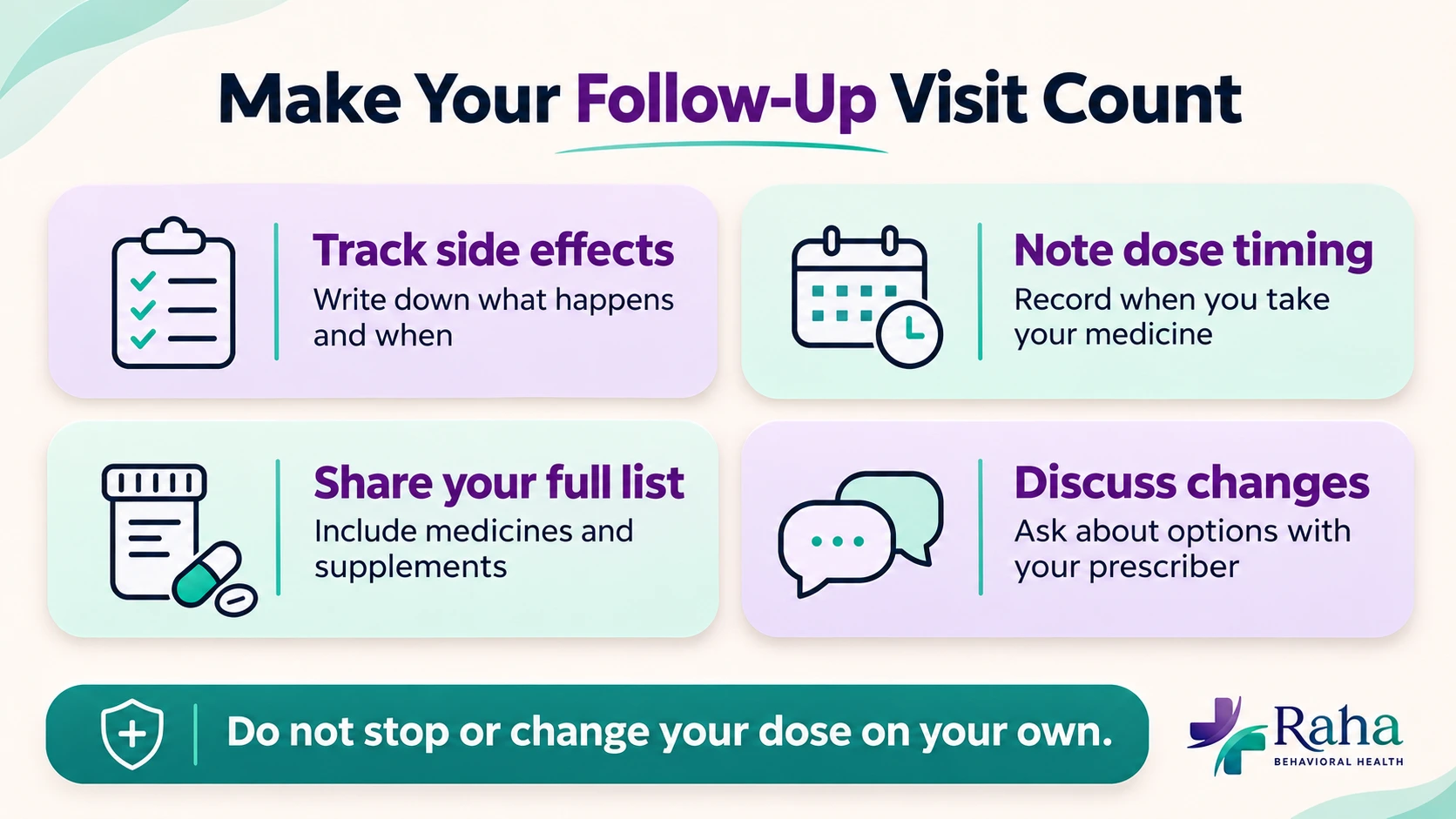
- Keep a short note each day with the side effect, the time you took your dose and how strong it felt. A pattern is much easier for your provider to work with than a memory.
- Tell your provider about everything else you take. That includes other medicines, supplements, herbs, alcohol and recreational drugs, since some combinations can raise the risk of side effects.
- Use one pharmacy so one place can check your medicines against each other.
- Ask about timing. Some side effects change depending on when in the day you take the dose.
- Keep your follow up visits. Early visits are where dose changes and medicine switches get decided.
If a side effect is strong, do not try to fix it by changing the dose yourself. A provider can adjust the dose, change the timing or move you to a different medicine.
Which antidepressant side effects should you report right away?
Some signs are not part of the usual settling in. Contact a provider straight away, or get emergency help, if you notice any of the following.
Thoughts of suicide or self harm. Children, teens and young adults under 25 may have more suicidal thoughts or behavior when starting an antidepressant or changing the dose, and this can be more likely in the first few weeks. Anyone starting an antidepressant should be watched closely for worsening mood or unusual behavior, by themselves and by the people close to them. If you are in crisis, call or text 988, or call 911 if you are in immediate danger.
Signs of serotonin syndrome. This is rare, but it can be life threatening. It happens when serotonin builds up too high, most often when two medicines that raise serotonin are combined. Warning signs include agitation, jitteriness, a high fever, heavy sweating, confusion, shaking, muscle twitches, poor coordination, big changes in blood pressure and a fast heartbeat. Get medical help right away.
Racing or impulsive thoughts with unusually high energy. This can be a sign of a different condition, such as bipolar disorder, and it needs a prompt call to a doctor.
Heart symptoms. Some antidepressants can affect heart rhythm. A fast or uneven heartbeat, fainting or chest pain needs attention, and your provider should know about any heart condition you have before you start.
A side effect that is severe, getting worse or not improving. You do not need to be in an emergency to call. Any side effect that worries you is worth a conversation.
Mild or serious: how can you tell?
| Usually part of settling in | Call your provider soon | Get help right away |
|---|---|---|
| Mild nausea, headache, dry mouth, sleep changes in the first weeks | A side effect that is strong, getting worse or still there after several weeks | Suicidal thoughts or urges to self harm |
| Mild dizziness or sweating | Weight, appetite or sexual changes that bother you | High fever, confusion, shaking, muscle twitches, fast heartbeat |
| Feeling slightly restless or off for a few days | Feeling more anxious, agitated or low than before | Racing thoughts with unusually high energy |
When you are not sure which column a symptom belongs in, call and ask. Providers would rather hear from you early.
Should you stop the medicine if side effects bother you?
No, not on your own. Stopping suddenly, or missing several doses, can cause withdrawal like symptoms, sometimes called discontinuation syndrome. These can include restlessness, anxiety, nausea, dizziness, feeling sluggish or sleepy and flu like symptoms. They usually begin within a few days of stopping and last a few weeks.
Stopping too quickly can also let depression come back. Antidepressants are not habit forming, but they are meant to be lowered slowly and safely with a provider, sometimes over weeks or months. Feeling better is not a sign to stop either. Treatment usually continues for months after symptoms improve, and often 6 to 12 months in total, so that you stay well.
If the side effects are the reason you want to stop, say so. That is useful information, and it opens up other options, such as a new dose, a new time of day or a different medicine.
Five things people get wrong about antidepressant side effects
“If I get side effects, the medicine is wrong for me.” Not always. Many early side effects fade within weeks. If they do not, a different medicine may fit better, and it can take more than one try to find the one with the fewest side effects for you.
“No side effects means it isn’t working.” Not everyone has side effects, and having none is fine. Relief and side effects are separate things.
“I feel better, so I can stop.” Stopping a prescribed medicine without a provider is not advised, even when you feel well.
“Everyone gets the same side effects.” People differ a lot, and the type of antidepressant makes a difference too.
“Side effects are my problem to put up with.” They are part of treatment, and managing them is part of your provider’s job. Telling them is not complaining.
How do follow up visits help with side effects?
Follow up visits are where side effects get sorted out. Early on, providers often see people more often, since the first weeks are when side effects and mood changes are most likely to show up. At each visit your provider can ask how you are sleeping, eating and feeling, check for side effects and adjust the plan.
At Raha Behavioral Health, ongoing medication management includes dose adjustments and monitoring for side effects, interactions and safety, with earlier visits placed closer together. Some medicines also need lab work, which your provider will explain. Talking therapy can run alongside medicine, and approaches such as cognitive behavioral therapy can help while the medicine settles in.
Does the type of condition change what to expect?
Antidepressants are used for more than depression. They are also used for several anxiety disorders and other conditions, and the early weeks can feel different depending on why you take one. Our guide to anxiety medication covers that side of treatment.
If you are not sure whether what you feel is depression, anxiety or both, our post on depression vs anxiety explains the overlap, and the list of signs of depression shows what to watch for before it gets worse. Many people also find that sleep changes sit at the center of both treatment and side effects, and insomnia treatment is one place to look if sleep stays hard.
Mood changes can also look different across life stages. For example, depression in women and women’s mental health treatment are worth reading if hormones, pregnancy or the months after birth are part of your story.
Frequently asked questions
What are the most common side effects of antidepressants?
The most common are nausea, headache, sleep changes, dry mouth, dizziness, sweating, nervousness and sexual side effects. Appetite changes, with weight gain or weight loss, are common too. Not everyone has them, and many are mild.
How long do antidepressant side effects last?
Many ease within the first few weeks, and nausea and sleep problems are the ones that most often improve. Others, such as sexual side effects or weight changes, may continue for as long as you take the medicine. If a side effect lasts more than a few weeks or is hard to live with, tell your provider.
Do antidepressant side effects go away?
Many do. Your body adjusts to the medicine, and side effects often fade within weeks. If they do not, a provider can change the dose, the timing or the medicine itself.
Can antidepressants make anxiety or depression worse at first?
Some people feel more anxious, restless or agitated in the early weeks, and a few feel low or irritable. Children, teens and young adults under 25 can also have more suicidal thoughts in the first weeks or after a dose change. Tell your provider about any worsening mood right away, and call or text 988 if you are in crisis.
Is it okay to stop an antidepressant if I have side effects?
Not on your own. Stopping suddenly can cause withdrawal like symptoms, and it can let depression return. Call your provider, who can lower the dose slowly or switch you to a medicine that suits you better.
What does serotonin syndrome feel like?
Early signs include agitation, jitteriness, sweating, shaking and a fast heartbeat. It can progress to a high fever, confusion, muscle twitches and big changes in blood pressure. It is rare and most often happens when two medicines that raise serotonin are combined, so get medical help right away if you notice these signs.
Why do I feel worse before I feel better on an antidepressant?
Antidepressants take about 4 to 8 weeks to work, and side effects often show up first. Sleep, appetite, energy and concentration may improve before your mood does. Keep your follow up visits, and tell your provider how the first weeks are going.
How do I know if an antidepressant is working?
Look for gradual changes in sleep, appetite, energy and concentration before a lift in mood. Because the full effect takes 4 to 8 weeks, a provider will usually check in during that window. If you feel no change after that time, it is worth a conversation about the dose or the medicine.
Talk to Raha About Medication Side Effects
Side effects are one of the main reasons people lose confidence in treatment, and one of the most fixable. You do not need to push through them alone. If you are starting an antidepressant, are in the middle of the adjustment period or are worried about how you feel on one, we can help you sort out what is normal and what needs a change.
Raha Behavioral Health offers depression treatment and medication management in Houston, TX, along with other support for mood disorders. You can meet our providers, contact us with questions or request an appointment when you are ready.
Sources
- Antidepressants: Get tips to cope with side effects, Mayo Clinic
- Selective serotonin reuptake inhibitors (SSRIs), Mayo Clinic
- Mental Health Medications, National Institute of Mental Health
- Antidepressants, MedlinePlus
- Antidepressants, NHS
Disclaimer: This post is for general information only and is not medical advice. It does not replace an evaluation by a licensed provider. Do not start, stop or change a medicine without talking to your prescriber. If you are in crisis or thinking about harming yourself, call or text 988 or call 911.