

Yes. Sleeping too much is a known symptom of depression. Many people think depression only means trouble sleeping, but some people with depression sleep much longer than usual and still wake up tired. Oversleeping can also come from other causes, such as sleep apnea or a body clock that is off, so it helps to have it checked. If you have been sleeping more than you need and your mood, interest, or energy have dropped for more than a week or two, it is a good time to talk to a professional.
This guide explains how depression and oversleeping are linked, what the signs look like, what else can cause heavy sleep, what you can try at home, and when to get help. It is for general education and is not a diagnosis.
Can depression make you sleep too much?
Depression can change sleep in two directions. Some people cannot fall asleep or wake up too early. Others sleep far more than they need. Both are listed as symptoms of depression. Oversleeping has its own medical name, hypersomnia.
During a depressive episode, symptoms are present most of the day, nearly every day. Sleep changes are one of several symptoms. The others include low mood, loss of interest in things you used to enjoy, changes in appetite, low energy, trouble focusing, and feelings of guilt or worthlessness.
So if you sleep 10 hours or more, still feel drained, and also feel low or numb, depression may be part of the picture. It does not prove depression by itself, but it is a reason to look closer.
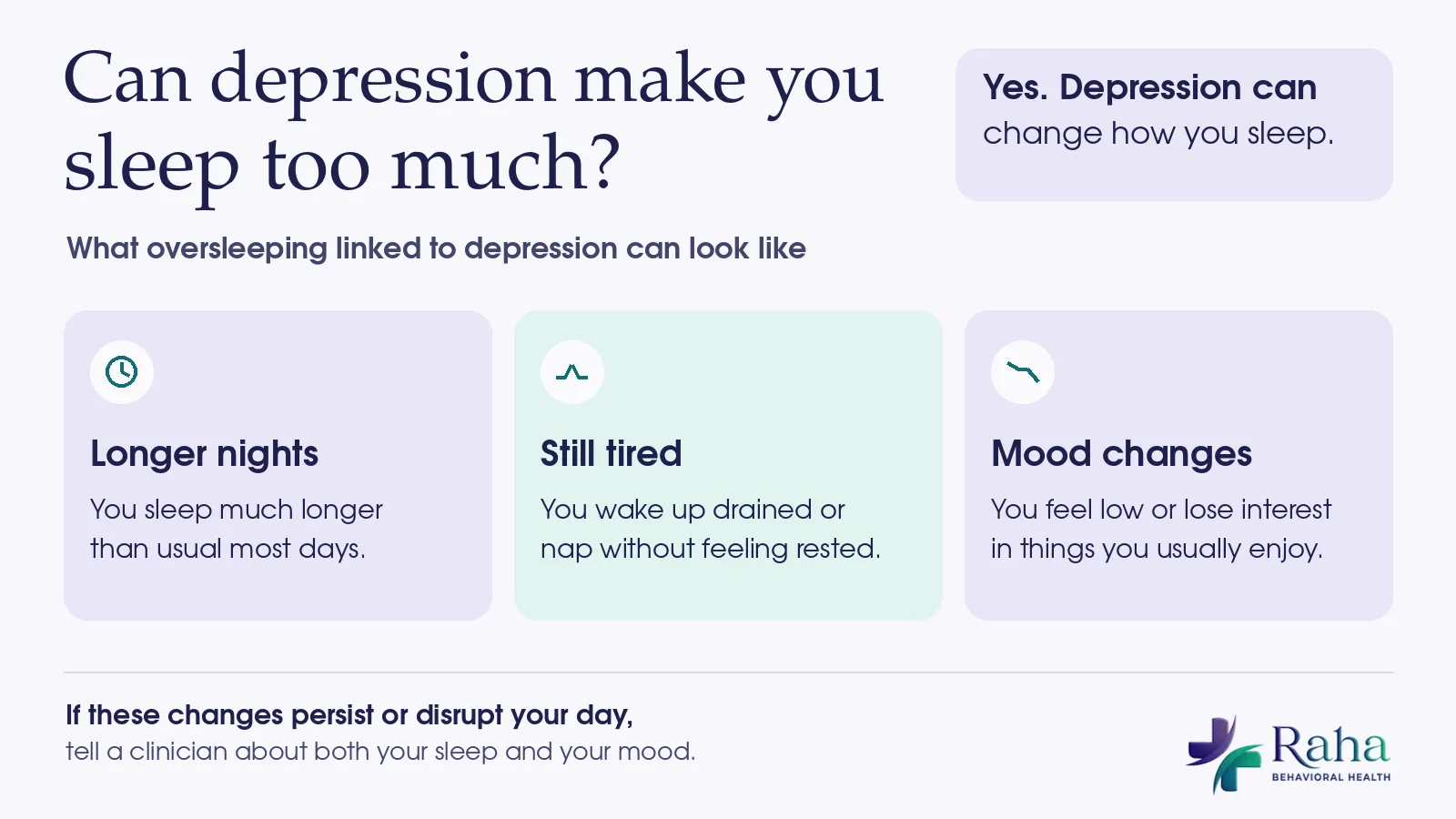
What does oversleeping from depression look like?
Oversleeping from depression is more than a lazy weekend. It tends to look like a pattern that you cannot easily break. Common signs include:
- Sleeping much longer than you used to, most days
- Finding it very hard to get out of bed, even after a full night
- Feeling heavy, slow, or tired even after long sleep
- Taking long naps and still feeling worn out
- Using sleep to escape a low mood or to avoid the day
- Spending long stretches in bed awake or half asleep
- Losing interest in things you used to enjoy
- Eating more than usual
Here is a simple way to compare ordinary tiredness with oversleeping linked to depression:
| Ordinary tiredness | Oversleeping linked to depression | |
|---|---|---|
| How long it lasts | A few days, often after a hard week or poor sleep | Weeks or longer |
| After long sleep | You feel better | You still feel tired or heavy |
| Mood | Mostly normal | Low, numb, or irritable |
| Interest in life | Still there | Fading |
| Daily life | You can keep up | Work, school, or home tasks start to slip |
If most of the right column sounds familiar, consider talking to a professional. Our guide on signs of depression before they get worse covers other early signs to watch for.
How much sleep is too much?
Most adults do well with about 7 to 9 hours of sleep. Teenagers usually need about 8 to 10 hours. Regularly sleeping more than 9 or 10 hours a night can leave you feeling worse, not better.
There is no single hour count that decides it. What matters more is how you feel and how your days are going. Sleeping 10 hours and waking refreshed, with a normal mood, is different from sleeping 10 hours and waking exhausted and flat.
A few signs that sleep may be too much:
- You sleep long hours but never feel rested
- You cannot stay awake during the day
- Your mood and interest have dropped
- Your usual activities no longer feel worth the effort
How common is oversleeping in depression?
It is common, though studies give different numbers. Estimates range from about 15 percent of people with depression to nearly half in some studies, depending on how researchers define and measure oversleeping. A recent medical review says up to 25 percent of people with depression have excessive sleepiness or hypersomnia.
Trouble sleeping is even more common than oversleeping. In one study of more than 3,500 people with major depression, over 92 percent reported sleep trouble. Insomnia was the most frequent problem, and almost half also had hypersomnia.
The takeaway is simple. If you sleep too much and feel depressed, you are not unusual. Many people with depression have the same pattern.
Why does depression make people sleep too much?
Researchers do not have one clear answer. Several things may play a part, and they can overlap.
Changes in brain chemistry and activity. Some researchers think that parts of the brain that keep you alert and active during the day may be less active in depression. That could leave you feeling sleepy and slow.
A body clock that is off. Your body clock tells you when to sleep and when to wake. In some people with depression, this clock may run longer than usual and respond less to light. That can make mornings very hard.
Time spent in bed. Some people with depression spend long hours in bed without sleeping the whole time. Lying in bed can feel safer than facing the day, and it can become a habit.
Broken sleep at night. Sometimes nighttime sleep is light and broken because the mind stays alert. The person then feels very sleepy in the day, which can look like oversleeping.
Sleep inertia. This is the groggy, foggy feeling right after waking. Some people with depression have a strong version of it, which makes getting up feel nearly impossible.
Experts also say that oversleeping in depression often has no clear medical explanation. That is one reason it deserves a careful look.
What is atypical depression, and does it cause oversleeping?
Atypical depression is a form of depression that often comes with oversleeping. The word “atypical” does not mean rare or unusual in a strange way. It describes a pattern.
In atypical depression, mood may lift for a short time after something good happens, but the underlying depression stays. Other signs can include a bigger appetite and being very sensitive to rejection. Oversleeping is more often linked to this pattern than to other forms of depression.
If your low mood brightens briefly when something good happens, then drops again, and you sleep and eat more than usual, mention this to a clinician. It helps them understand which type of depression you may have. Our guide on mood disorders: symptoms and treatment explains the wider group of mood conditions.
Can sleeping too much make depression worse?
It can feed the cycle. Most of the evidence suggests oversleeping is a symptom of depression, not the cause of it. But the link can go both ways. One study found that people who sleep more than 8 hours may have more depressive symptoms than people who sleep 8 hours or less.
Here is how the cycle often works:
- Mood drops, and sleep gets longer.
- Long sleep means less daylight, less movement, and fewer activities.
- With less activity, mood stays low or drops further.
- Low mood makes it even harder to get up.
Sleep problems that are left alone can also make depression harder to treat. Experts say that sleep problems can stay even after depression improves, because the sleep habits become fixed. So it helps to treat the mood and the sleep pattern together.
Oversleeping linked to depression has also been tied to depression that is harder to treat and to poorer outcomes. That is another reason to bring it up with a professional, not to wait it out. It can also raise safety concerns, such as drowsiness while driving.
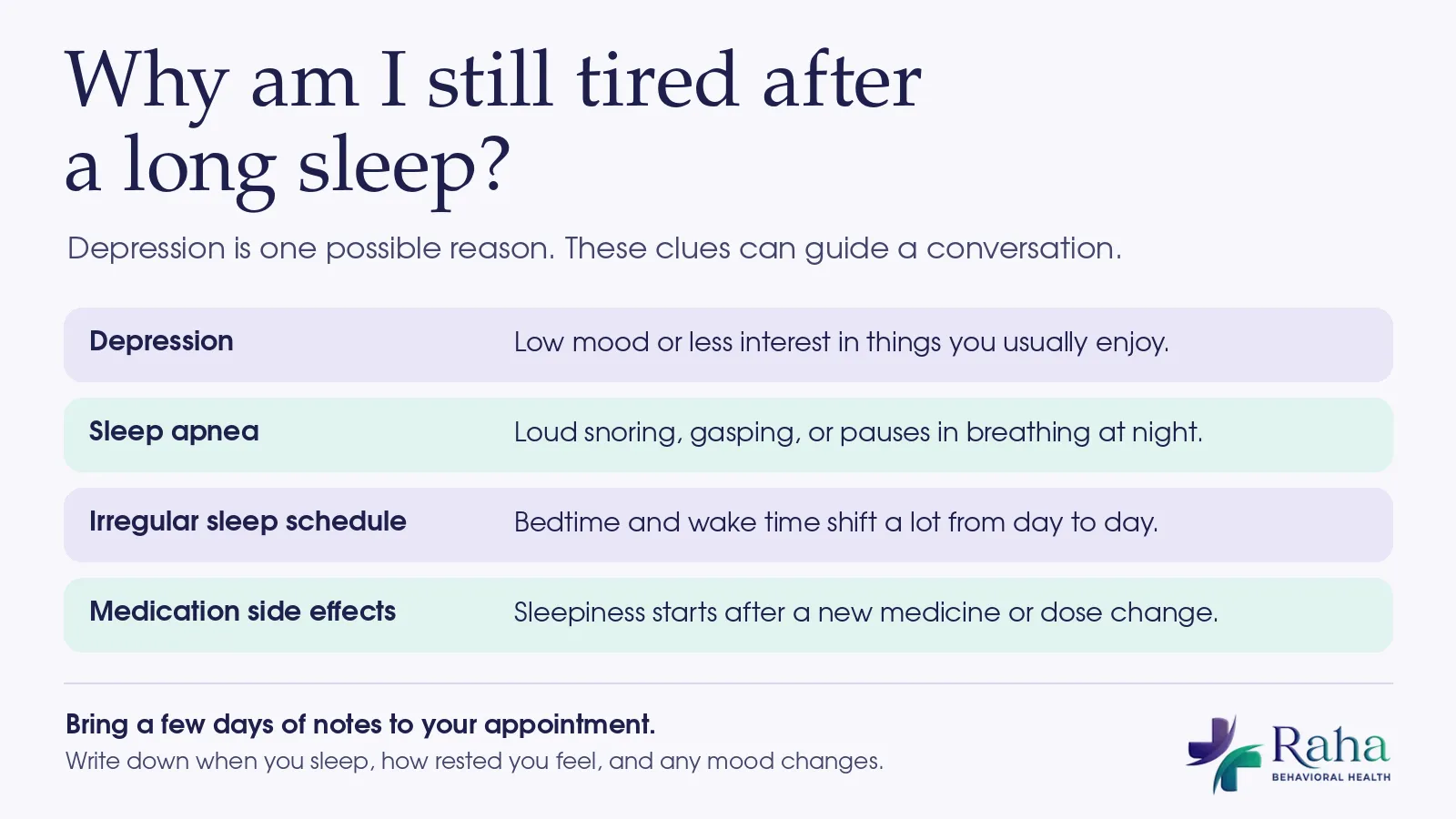
What else can cause sleeping too much besides depression?
Several things other than depression can make you sleep too much. A good evaluation looks at all of them.
- Sleep apnea. In sleep apnea, breathing pauses during sleep. Sleep is not restful, so people may sleep long hours and still feel tired. Sleep apnea is common in people with depression.
- A sleep disorder called hypersomnia. This is a condition marked by oversleeping and constant exhaustion. It can also bring trouble concentrating, memory problems, irritability, and anxiety.
- An irregular sleep schedule. Going to bed and waking up at very different times can throw off your body clock.
- Medicine side effects. Some medicines can make people sleepy. If you recently started or changed a medicine, mention it.
- Other medical or sleep conditions. Conditions such as narcolepsy and some movement related sleep problems need a specialized assessment.
This is why a careful review matters. Treating depression will not fully help if sleep apnea is part of the problem, and treating sleep alone will not fully help if depression is part of the problem.
If you also struggle to fall or stay asleep at night, our page on insomnia treatment in Houston and our post on persistent sleep problems and mental health may help.
Is it depression or just being tired?
Everyone has tired stretches. Stress, poor sleep, illness, and busy seasons can all make you sleep more for a while. The difference with depression is how long it lasts and what comes with it.
Ask yourself these questions:
- Has this lasted more than one or two weeks?
- Do I feel unrested no matter how long I sleep?
- Have I lost interest in things I normally enjoy?
- Do I feel low, empty, numb, or hopeless most of the day?
- Has my mood started to affect work, school, family, or friends?
- Am I eating much more or much less than usual?
- Do I find it hard to stay awake in the daytime?
If you answered yes to several of these, it is a good idea to talk to a health professional. For a diagnosis of depression, symptoms need to be present most of the day, nearly every day, for at least two weeks, and one of them must be a low mood or a loss of interest or pleasure.
A major life event can also bring heavy tiredness. Our post on major life changes and your mental health explains how to tell a hard season from something more.
Can depression cause both insomnia and oversleeping?
Yes. Depression can show up as too little sleep, too much sleep, or a mix of both at different times. Some people have nights of broken sleep and then sleep for hours the next day. Others notice the pattern change from one episode to the next.
Sleep changes in depression are also common in other ways. Waking too early in the morning is another typical pattern. Because sleep can swing either way, the best clue is not the exact number of hours. It is whether your sleep has changed from your normal and whether other symptoms came with it.
What can you do at home to sleep better with depression?
Home steps do not replace treatment, but they can support it. Experts suggest these:
Keep the same wake time every day. Include weekends. A steady wake time helps reset the body clock.
Skip the snooze button. Repeated snoozing gives you short, broken sleep and can make morning grogginess worse.
Get morning light. Open the curtains or step outside soon after waking. Daylight helps the body clock.
Cut bright light before bed. Dim the lights and put screens away in the hour before sleep.
Get moving. Even a short walk or some stretching after you wake up can help you feel more awake.
Eat something light and drink water. A light breakfast with some protein can help you start the day.
Set one small goal. Pick one small task for the morning, such as a shower or a short walk. Small wins can break the cycle of staying in bed.
Use the bed for sleep. Try not to spend long hours lying in bed awake.
None of these steps will cure depression. They can make the day a little easier while you get proper care. Our post on how depression affects work and daily responsibilities shares ways depression can show up in daily life.
When should you see a professional about oversleeping?
Make an appointment with a doctor or mental health professional as soon as possible if you feel depressed. Do not wait for it to get worse. It is also a good idea to get help if:
- Depression symptoms last longer than one or two weeks
- You never feel rested, no matter how much you sleep
- You cannot stay awake during the day
- Your usual activities no longer interest you
- Your mood is affecting your daily life or relationships
If you are reluctant to seek help, you can start by talking to a friend, a loved one, or someone you trust. Telling someone is a real first step.
When you go, tell the professional about all your symptoms, not only the sleep. Depression and sleep disorders can overlap, so the full picture helps.
How is depression with oversleeping treated?
Depression is treatable, and oversleeping often improves as the depression improves. A clinician looks at your symptoms, your sleep, your health, and your history before suggesting care. Common parts of care include:
Talk therapy. Therapies such as cognitive behavioral therapy (CBT) and interpersonal therapy are common choices, and they can be done in person or by video. Some therapies also focus on getting active again, which can help when you are stuck in bed.
Medication. Antidepressant medicines are one option. They typically take about 4 to 8 weeks to work, so patience and regular follow ups matter. Some people also need a closer look at sleep or other health issues alongside medicine.
Sleep focused care. If sleep apnea or another sleep disorder is suspected, a sleep medicine evaluation may be needed. Researchers are also studying approaches such as tailored light therapy and CBT made for oversleeping.
Brain stimulation. For depression that has not improved with other care, there are brain stimulation options. These are usually considered after other approaches have been tried.
Experts note that sleep habits can stay changed even after mood improves, so a sleep routine is a useful part of recovery.
You can read more about how therapy and medicine fit together in our guides on medication or therapy and what medication management is and how it works.
How can Raha Behavioral Health help with depression and oversleeping in Houston?
Raha Behavioral Health helps adults in Houston and nearby areas who are dealing with depression, including people who keep working while they struggle. Care includes:
- A psychiatric evaluation. The first visit is a longer intake, usually about an hour, so the team can understand your symptoms, your sleep, and your history.
- Medication management and therapy in one place. You can get both at Raha, and therapy can be offered alone or alongside medication. Therapy approaches include cognitive behavioral therapy, interpersonal therapy, behavioral activation, and mindfulness based cognitive therapy.
- A clear view of your sleep. The team can talk about sleep concerns alongside your mental health. A psychiatric appointment is not a sleep study, and a prescription is not automatic. When needed, the team can discuss whether a sleep medicine or medical evaluation is the right next step.
- Visits in person or by video. Raha is located at 5850 San Felipe St, Ste 500, Houston, TX 77057, and offers secure video visits you can join from a private place.
Learn more on the depression treatment in Houston page, the sleep disorder treatment in Houston page, or the medication management in Houston page. If you want talk therapy, see adult psychotherapy in Houston and cognitive behavioral therapy in Houston. You can also meet the Raha providers.
Ready to talk? Request an appointment or call (832) 968-7328. The front desk answers Monday to Friday, 9 AM to 6 PM.
When is oversleeping and low mood an emergency?
If you have thoughts of ending your life or hurting yourself, do not wait for an appointment. In the U.S., call or text 988 to reach the 988 Suicide and Crisis Lifeline. It is free, confidential, and open 24 hours a day, seven days a week. In a life threatening emergency, call 911.
Quick answers: depression and sleeping too much
Can depression make you sleep 12 hours a day?
Yes, it can. Some people with depression sleep very long hours and still feel tired. Long sleep is not proof of depression on its own, so a clinician should also check for other causes such as sleep apnea or a sleep disorder.
Why am I so tired all the time and depressed?
Depression can drain energy even when you sleep a lot. It can also change sleep patterns and the body clock. Other causes, such as sleep apnea, can add to the tiredness. A professional can sort out which ones apply to you.
Is sleeping a lot a sign of depression?
It can be. Sleeping too much is listed as a symptom of depression, along with low mood, loss of interest, and low energy. Look at the whole picture, not only the hours.
What is hypersomnia in depression?
Hypersomnia means sleeping too much or feeling extremely sleepy during the day. In depression, it can show up as very long sleep, heavy morning grogginess, or long naps that do not refresh you.
Does sleeping too much cause depression?
Most evidence suggests oversleeping is a symptom of depression, not the cause. But the link can work both ways, and long sleep can keep low mood going by reducing daylight and activity.
How do I stop oversleeping from depression?
Keep a steady wake time, skip the snooze button, get morning light, and add small activities. These steps support recovery, but depression usually needs professional care too.
When should I see a doctor about oversleeping?
See a professional if oversleeping lasts more than a week or two, you never feel rested, you cannot stay awake in the day, or your mood and interest have dropped.
Can antidepressants help with oversleeping?
For some people, treating the depression helps sleep return to normal. Medicine is one option among several, and it usually takes 4 to 8 weeks to work. A prescriber can explain what fits your situation. Do not start, stop, or change medicine on your own.
Medical disclaimer: This article is for general education only. It is not medical advice and cannot diagnose any condition. Oversleeping can have many causes, and only a qualified clinician who knows your history can tell you what is behind it. Do not start, stop, or change any medicine without talking to your prescriber. If you are in crisis or thinking about harming yourself, call or text 988 or call 911.
Sources
- Cleveland Clinic. What You Should Know About the Relationship Between Oversleeping and Depression. June 25, 2020.
- Healthline. Can Too Much Sleep Cause Depression? Here’s What to Know. Medically reviewed by Matthew Boland, PhD. Updated September 26, 2024.
- Mayo Clinic. Depression (major depressive disorder): Symptoms and causes. September 1, 2026.
- National Institute of Mental Health. Depression. Revised 2024.
- Biological Psychiatry Global Open Science. Pathophysiological Models of Hypersomnolence Associated With Depression. 2024.