

Sometimes, yes. But not the way most people hope. No pill switches anger off. What medication can do is treat whatever is sitting underneath the anger, like depression, anxiety, ADHD, bipolar disorder or PTSD, and once that thing settles down, the short fuse usually gets longer. Most people do best when medication goes hand in hand with therapy that teaches them what to do in the moment.
Maybe you snapped at your kid over spilled juice and then felt awful all evening. Maybe you’re a partner who’s tired of watching someone you love blow up over nothing. Either way, this guide walks through when medication makes sense, what’s usually behind the anger, how the treatment works, and what to do besides taking a pill. You don’t have to read it in order. Every section answers its own question.
Can medication help with anger and irritability?
It can, when the anger comes from a health problem and not just from a rough week. Think of it this way: if you’re irritable because untreated depression has worn you down, treating the depression is what helps. The medicine isn’t taming your temper directly. It’s fixing the thing that keeps lighting it.
Plenty of anger is perfectly normal. Getting mad at being treated unfairly is part of being human. The red flag is when it feels out of control, when you say or do things you regret, or when the people around you start walking on eggshells. At that point it’s worth asking a prescribing provider what’s going on underneath. For some people the answer is a mood condition. For others it’s ADHD, trauma, or a pattern of sudden explosive outbursts.
And sometimes the honest answer is no, you don’t need medication. If your anger mostly comes from stress, burnout or a situation that’s hard to live in, skills and therapy will likely do more than a prescription. An evaluation is how you find out which camp you’re in, and our page on medication management explains how that conversation goes.
Is there a medication for anger?
Not one made for plain, everyday anger. Providers prescribe for the condition that’s causing it, so which medicine you’d get, or whether you’d get one at all, depends on your diagnosis.
There’s one exception worth knowing about. Intermittent explosive disorder, often shortened to IED, is a condition where the outbursts themselves are the main problem. Someone with it can go from calm to furious in seconds, with a reaction far bigger than the situation deserves. These episodes usually last under 30 minutes. Right before one, people often feel rage, racing thoughts, shaking, a pounding heart or a tight chest. Afterward comes the crash: relief, exhaustion, then guilt or embarrassment. It often starts in childhood or the teen years.
For IED, treatment typically means talk therapy plus medication. Antidepressants are commonly used, and a provider may add mood stabilizers or other medicines if needed. Some people stay on medication long term to keep outbursts from coming back.
Most people reading this don’t have IED, though. For them, anger is one symptom in a bigger picture, which is why the next question matters so much.
What conditions can cause anger and irritability?
A handful of very common ones. Depression, anxiety, ADHD, bipolar disorder and PTSD can all show up as irritability, and so can plain lack of sleep and substance use. The table below shows how each one tends to look and where treatment usually points.
| Condition | How anger or irritability can show up | Where medication may fit |
|---|---|---|
| Depression | Angry outbursts or frustration over small things. In teens, irritability is a common sign | Antidepressants and therapy. See depression treatment |
| Anxiety | Irritability alongside muscle tension, tiredness and trouble sleeping | Anti-anxiety medicines and therapy. See anxiety treatment |
| ADHD | Low frustration tolerance, a quick temper, mood swings, acting before thinking | ADHD medicines and therapy. See ADHD testing |
| Bipolar disorder | Irritable, wired behavior during manic episodes, with very low stretches in between | Mood stabilizers and other medicines, plus therapy. See bipolar disorder treatment |
| PTSD | Anger, jumpiness, feeling constantly on guard | Therapy first, medication sometimes added. See trauma and PTSD treatment |
| Intermittent explosive disorder | Sudden, extreme outbursts out of proportion to the trigger | Therapy plus medication, often an antidepressant |
| Poor sleep | Feeling worn out, short tempered and unable to focus | Sleep care first. See insomnia treatment |
| Alcohol and drug use | Higher risk of aggression and outbursts | Treating the substance use itself. See addiction treatment |
Notice that the same symptom, irritability, points in very different directions. That’s why guessing doesn’t work. It’s also common to have two of these at once, like ADHD with poor sleep, or depression with anxiety. If you’re trying to tell which is which, depression vs anxiety and mood disorders lay out the differences.
What types of medication are used for anger and irritability?
Providers draw from a few families of medicine: antidepressants, mood stabilizers, ADHD medicines, anti-anxiety medicines and, in certain cases, antipsychotics. Which family fits depends on the diagnosis, and that’s a decision you make together with a prescribing provider after an evaluation.
Antidepressants treat depression and anxiety, and they’re commonly used for IED too. Since irritability is such a common sign of depression, easing the depression often takes the edge off. Our guide to depression treatment goes deeper.
Mood stabilizers are the usual choice for bipolar disorder. If your irritability comes in waves, with stretches of high energy and then very low periods, this is the kind of treatment aimed at that pattern. Bipolar disorder explains what it looks like day to day.
ADHD medicines, which are stimulants, boost attention and alertness. That matters for anger because a short fuse, impatience and low frustration tolerance are common in adults with ADHD. When the ADHD is treated, daily frustrations stop piling up as fast. You can read more in ADHD signs, symptoms and treatment and what happens after an ADHD diagnosis.
Anti-anxiety medicines calm symptoms like panic and constant worry. Some are meant for short-term use only, because using them for a long time can lead to tolerance or dependence. If tension and worry are what’s driving your temper, generalized anxiety disorder treatment is a good place to start.
Antipsychotics come into play when psychosis is part of the picture, which can happen in schizophrenia, bipolar disorder or severe depression. Agitation often settles within days on these medicines, though the full effect can take longer. Our pages on agitation signs, causes and treatment and agitation treatment cover that side.
None of these is a “calm down” pill, and none should be started on a hunch.
How long does medication take to work for anger?
Longer than most people expect. We’re usually talking weeks, not days. Antidepressants typically take about 4 to 8 weeks, and things like sleep, appetite, energy and concentration often improve before your mood does. Antipsychotics can ease agitation within days, but reaching their full effect can take up to six weeks.
This is where people get discouraged. They give it a few days, feel nothing, and quit. Then they never learn whether it would have worked. It’s also normal to try more than one medicine, or to adjust the dose along the way, before landing on the right fit. If you want to see how timelines play out for a related condition, how long anxiety treatment takes is a useful comparison.
What are the side effects of anger and irritability medication?
It depends on the medicine. Many side effects are mild and fade as your body adjusts, but some need keeping an eye on.
With antidepressants, people commonly notice an upset stomach, headaches or sexual side effects. ADHD stimulants can raise blood pressure, heart rate and breathing rate, and they can mess with sleep. Some antipsychotics call for regular checks of weight, blood sugar and cholesterol, and mood stabilizers can mean blood tests to see how your body is handling the medicine.
A few cautions stand out. People under 25 who take antidepressants can have more suicidal thoughts or behavior, especially early on or after a dose change, so close follow-up matters. Some anti-anxiety medicines can cause dependence if used for a long time. And alcohol and street drugs fuel aggression, so they work directly against what you’re trying to do.
If a medicine seems to be doing more harm than good, tell your provider. Please don’t stop it on your own, since stopping suddenly can cause unpleasant or even harmful effects. Your provider can bring the dose down slowly and safely.
Does medication work better with therapy for anger?
For most people, yes. Medicine can turn down the intensity of what you feel, but it can’t teach you what to do with the feeling. Therapy does that. Anger problems are usually treated with both, and no single approach works for everyone.
The go-to therapy is cognitive behavioral therapy, or CBT. In sessions you learn to spot the situations and thoughts that set you off, practice calming techniques like slow breathing, check whether your expectations are realistic, work through problems without aggression, and respond instead of react. Anger management programs often mix one-on-one counseling with group sessions and usually include CBT. They can last anywhere from a single day to several months.
To see what that looks like here, read about cognitive behavioral therapy, anger management treatment and adult psychotherapy.
What can medication not do for anger?
It can’t teach you skills, fix a bad situation, or erase normal anger. What it can do is lower the biological pressure behind irritability. It won’t change how you talk to your partner, how you handle a brutal week, or what’s going on in your relationships.
It also isn’t the answer when there’s no underlying condition. If your anger comes mostly from a stressful job, a tough home situation or pressure that’s been building for months, therapy and changes to your daily life will likely help more. Stress management therapy and the stress management guide go further, and mental overload explains how pressure stacks up until a tiny thing sets you off.
How do you know if your anger is a medical problem?
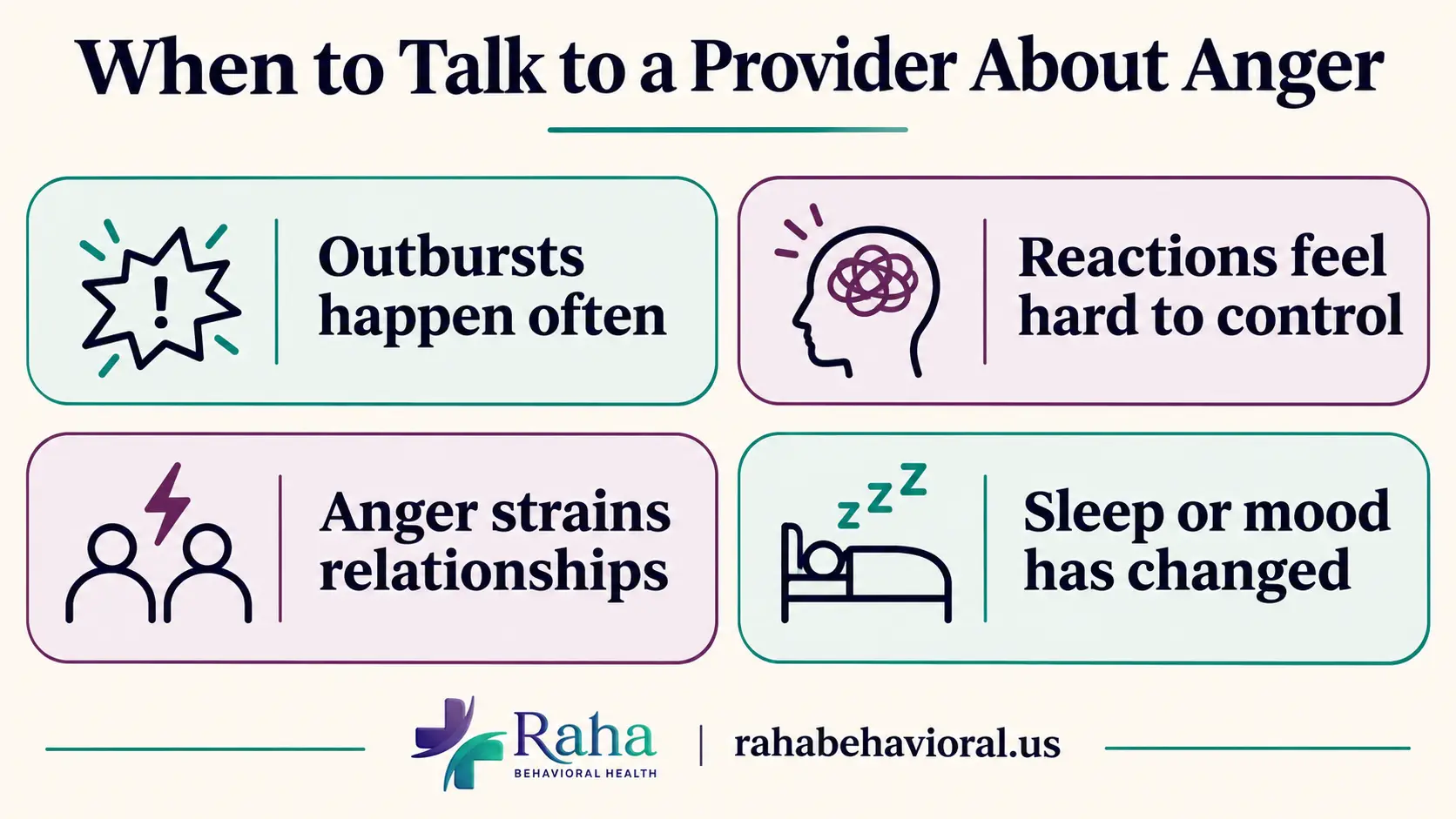
Pay attention if it feels out of control, leads to things you regret, hurts people around you, or arrives with other symptoms like low mood, constant worry or bad sleep. Some signs worth noticing:
- Your reactions are much bigger than the situation.
- Outbursts come on suddenly, with little warning.
- Your body reacts first, with a racing heart, shaking or a tight chest.
- You feel guilty or drained afterward.
- It’s causing trouble at work, at home or in relationships.
- You’ve also had low mood for over two weeks, or you’re sleeping badly.
If a few of these sound familiar, an evaluation can sort out what’s behind them. It usually includes a physical exam to rule out medical problems or substance use that could be playing a part, plus a conversation about your symptoms, thoughts, feelings and behavior.
You can also get better at catching anger early. Emotional flooding describes what happens when feelings overwhelm you fast, and emotional triggers helps you figure out what sets you off. If you tend to swallow everything and then explode, emotional regulation vs suppression is worth a read.
What should you tell a provider before starting medication?
Everything that could affect treatment. That means every other medicine, vitamin and supplement you take, any allergies, past trouble with medications, and any side effects or worries. Be upfront about alcohol and drug use too. Supplements belong on the list because they can interact with prescription medicines.
It also helps to describe the anger itself. How often does it happen? What sets it off? How long does it last, and how do you feel afterward? Jot down notes on your sleep, mood and stress. And don’t leave until you understand how to take the medicine. Good questions include what it’s meant to treat, how long it should take, which side effects to watch for, how you’ll be monitored, and what to do if you miss a dose.
What can you do alongside medication to manage anger?
Daily habits make a real difference, and they make medication work better. They also stay with you after treatment ends.
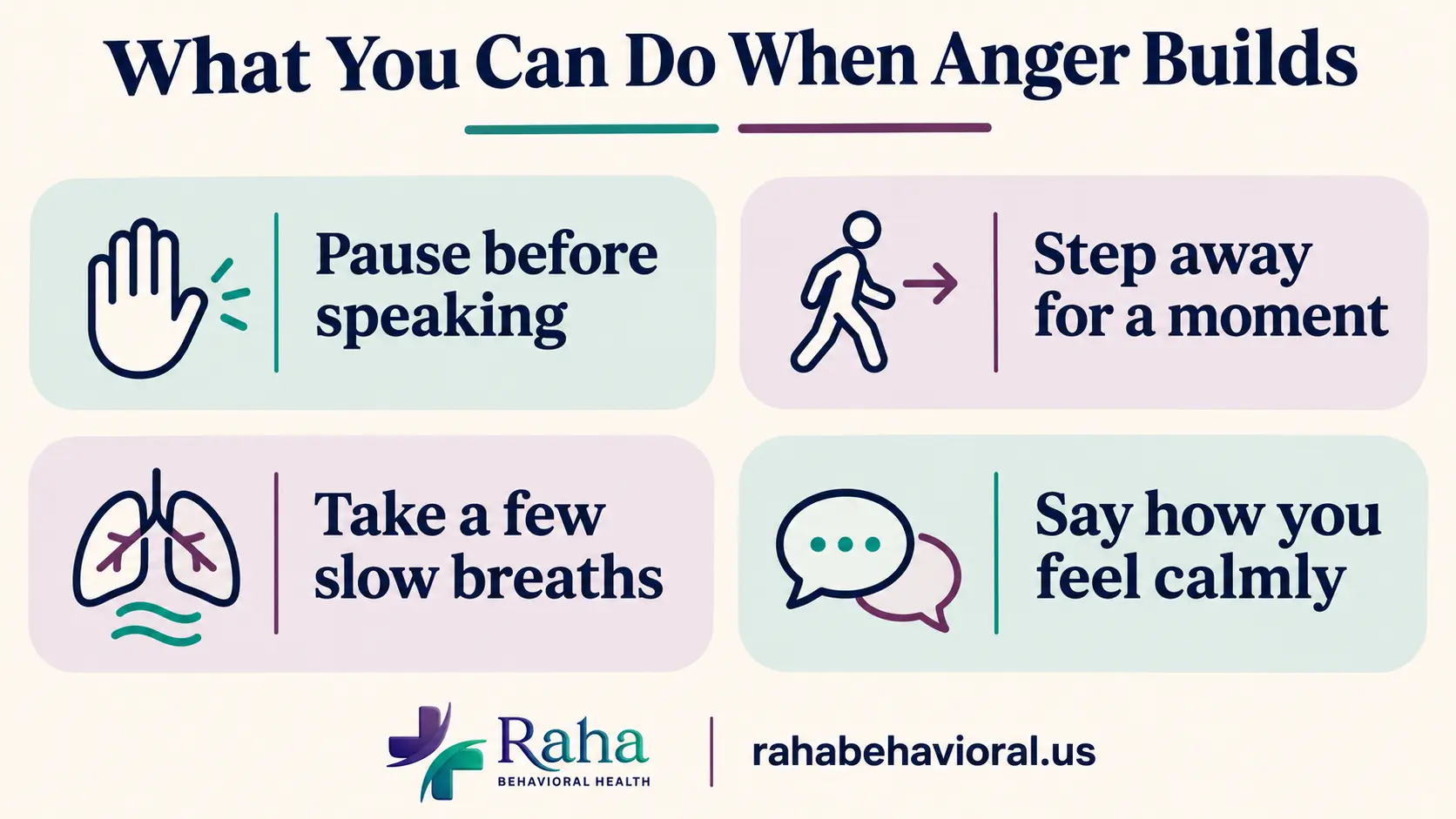
- Think before you speak. Take a moment to collect yourself, then say what you need once you’re calmer.
- Take a timeout. Short breaks during a stressful day help you stay level.
- Move your body. A brisk walk or a run burns off the stress that feeds anger.
- Practice relaxing. Slow belly breathing, repeating a calming phrase or picturing a peaceful scene lowers the physical rush. Practice when you’re calm so it comes easier when you’re not.
- Drop the “always” and “never.” Words like these make problems feel hopeless. Try more balanced thoughts.
- Use “I” statements. Saying “I feel overwhelmed” lands very differently than “you never help.”
- Protect your sleep. Tired people are irritable people.
- Skip alcohol and drugs as a coping tool. They raise aggression and work against treatment.
If your anger shows up mostly at home, relationship stress, family conflict and couples counseling cover support for that side. Parents stretched thin can look at parenting and family stress counseling, and coping skills development offers more structured practice.
What if someone you live with has angry outbursts?
Your safety comes first. If the person refuses treatment and the outbursts involve threats, physical fights or broken things, living with that is frightening, and you don’t have to just put up with it.
If you feel unsafe, make a plan. Know where you’d go, keep an emergency bag ready, secure any firearms, and have a way to signal for help. The National Domestic Violence Hotline is open at 1-800-799-7233, and in an emergency you should call 911. Counseling can help you cope as well.
And if you’re the one whose anger has turned abusive or violent, see a health care provider as soon as you can. Treatment works, and it’s far better to ask for help before something can’t be undone. If substance use is part of it, alcoholism treatment and addiction treatment are available.
Frequently asked questions
What is the best medication for anger and irritability?
There isn’t one best medication. The right choice depends on what’s causing the anger, whether that’s depression, ADHD, bipolar disorder, anxiety or PTSD. A prescribing provider decides after an evaluation, and therapy is usually part of the plan.
Can antidepressants help with anger?
They can. Irritability is a common symptom of depression, and antidepressants are also commonly used for intermittent explosive disorder. They usually take about 4 to 8 weeks to work.
Can ADHD medication help with anger and irritability?
It may, if ADHD is the cause. A quick temper, low frustration tolerance and acting without thinking are part of how adult ADHD can look, so treating it can ease those symptoms. A provider can tell you whether that fits you.
Can anxiety cause irritability?
Yes. Irritability is listed among the physical symptoms of generalized anxiety disorder, along with muscle tension, tiredness and trouble sleeping.
Can lack of sleep cause irritability?
Yes. Poor sleep leaves you tired and short tempered during the day and makes it hard to concentrate. If sleep problems have gone on for months, it’s worth getting help.
Is anger a mental illness?
No. Anger is a normal emotion. It becomes a concern when it’s out of control or hurting your life and relationships, and it can be a symptom of a mental health condition.
What is intermittent explosive disorder?
It’s a condition marked by sudden, extreme outbursts of anger that are out of proportion to the situation, usually lasting less than 30 minutes. It often begins in childhood or the teen years, and treatment usually combines therapy with medication.
How long does it take for anger medication to work?
It depends on the medicine. Antidepressants usually take about 4 to 8 weeks, while antipsychotics can ease agitation within days, with the full effect taking up to six weeks.
Can you stop taking medication once you feel calmer?
Not without talking to your provider first. Stopping suddenly can cause harmful effects, even when you feel better. A provider can lower the dose gradually.
Can therapy alone help with anger?
Often, yes. Anger management therapy, especially CBT, teaches you about triggers, relaxation, problem solving and communication. Many people use therapy alone, and others add medication when a condition is driving the anger.
Anger and Irritability Treatment in Houston
If anger or irritability is getting in the way of your life, Raha Behavioral Health can help you figure out what’s behind it and what treatment fits. You can learn about medication management, explore anger management treatment, and meet our providers. When you’re ready, contact us to get started.
Sources
- Mayo Clinic. Intermittent explosive disorder: Symptoms and causes
- Mayo Clinic. Intermittent explosive disorder: Diagnosis and treatment
- Mayo Clinic. Anger management: 10 tips to tame your temper
- Mayo Clinic. Depression (major depressive disorder): Symptoms and causes
- Mayo Clinic. Generalized anxiety disorder: Symptoms and causes
- Mayo Clinic. Adult attention-deficit/hyperactivity disorder (ADHD)
- Mayo Clinic. Post-traumatic stress disorder (PTSD): Symptoms and causes
- National Institute of Mental Health. Mental Health Medications
- National Institute of Mental Health. Bipolar Disorder
- NHS. Anger
- NHS. Insomnia
- NHS. Bipolar disorder: Treatment
- American Psychological Association. Controlling anger before it controls you
This article is for general information only and is not medical advice or a diagnosis. Talk with a licensed provider about your own health and before starting, changing or stopping any medication. If you are in crisis, call or text 988, or call 911 in an emergency.