

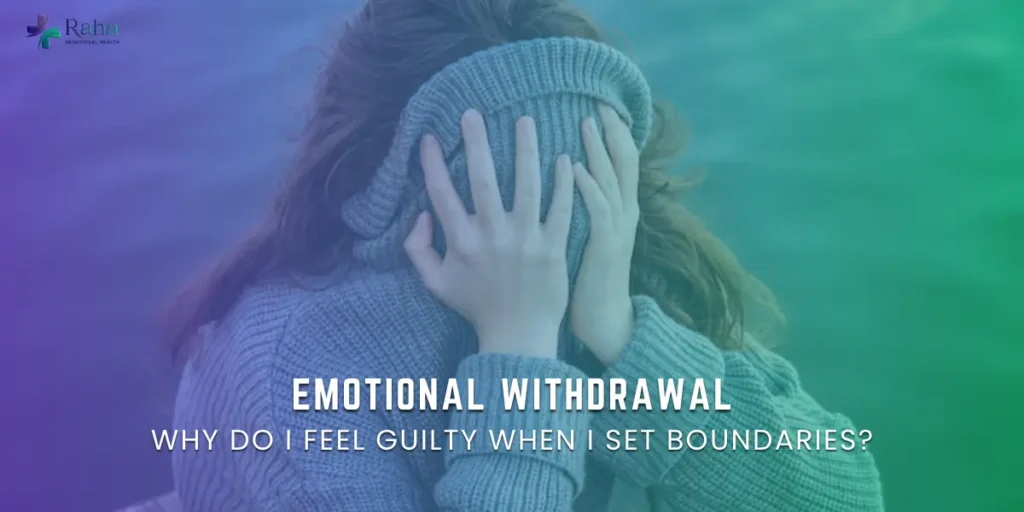
Have you ever said no to something you could not handle, only to feel guilty afterward? You may understand that you needed the boundary, yet still find yourself worrying that you disappointed someone. This conflict can be especially confusing when Emotional Withdrawal has already become part of how you cope with difficult relationships or uncomfortable feelings.
Emotional Withdrawal may involve pulling away emotionally, avoiding difficult conversations, or becoming less available when relationships feel overwhelming. For some people, Emotional Withdrawal develops alongside a strong fear of conflict, rejection, or disappointing others. Setting a boundary can then trigger guilt because saying no feels less like self-care and more like letting someone down.
But why does this happen? And does feeling guilty mean that your boundary was wrong?
Not necessarily. In many cases, guilt is a learned emotional response rather than proof that you have done something harmful. Understanding the connection between Emotional Withdrawal, people-pleasing, fear of conflict, and personal boundaries can help you respond to these feelings with greater self-awareness and compassion.
What Is Emotional Withdrawal?
Emotional Withdrawal refers to creating emotional distance from another person or from a relationship. It can happen intentionally or without conscious awareness. A person may stop communicating openly, avoid emotional conversations, suppress feelings, or become detached when a relationship becomes stressful.
Emotional distance is not always unhealthy. People sometimes need temporary space to calm down, process their feelings, or regain emotional balance. The concern arises when withdrawing becomes the primary way of handling interpersonal stress.
Someone experiencing Emotional Withdrawal may feel safer keeping thoughts and emotions private rather than expressing them directly. Over time, this can make meaningful communication more difficult. The person may want connection but simultaneously feel uncomfortable with vulnerability.
This can create an exhausting internal cycle. You may want closeness, but closeness feels demanding. You may want to communicate, but communication feels risky. You may want to establish limits, but the moment you do, guilt appears.
Why Can Setting Boundaries Trigger Guilt?
Boundaries define what you are comfortable with, what you can realistically give, and what you will or will not accept in a relationship. Healthy boundaries are a normal part of emotional well-being.
Still, knowing that boundaries are healthy does not automatically make them emotionally comfortable.
Guilt can appear when you have learned to prioritize other people’s needs over your own. If you have spent years trying to keep everyone satisfied, disappointing someone may feel deeply uncomfortable. Your mind may interpret another person’s frustration as evidence that you have done something wrong.
This reaction can also be connected to Emotional Withdrawal. When expressing your needs feels unsafe or uncomfortable, withdrawing may seem easier than having a direct conversation. You might remain silent, distance yourself, or agree to something you genuinely do not want.
Unfortunately, avoiding the discomfort does not always make the underlying problem disappear.
Guilt Is Not Always a Sign of Wrongdoing
One of the most important distinctions to understand is the difference between healthy guilt and conditioned guilt.
Healthy guilt can encourage you to reflect when your actions genuinely conflict with your values. Conditioned guilt, however, can arise simply because you have done something unfamiliar, such as saying no, asking for space, or protecting your time.
When boundaries are new, guilt may simply be your emotional system reacting to change.
That does not mean you should ignore every feeling of guilt. Instead, pause and ask yourself what the feeling is communicating. Did you violate your values, or did you simply disappoint someone? Those are not necessarily the same thing.
The Connection Between Emotional Withdrawal and Boundaries
Boundaries and emotional distance can sometimes look similar from the outside, but they serve different purposes.
A boundary communicates a limit while leaving room for healthy communication. Withdrawal often removes emotional engagement altogether. One establishes a healthier framework for interaction; the other may create distance without addressing the underlying issue.
For someone struggling with Emotional Withdrawal, setting a boundary can feel unfamiliar because it requires staying emotionally present while communicating a limit.
That can be challenging.
You might worry about how the other person will respond. You might replay the conversation repeatedly. You might feel responsible for their emotions. You may even consider abandoning the boundary simply to restore a sense of peace.
Yet healthy relationships do not require one person to continually sacrifice their emotional needs to prevent discomfort.
Why People-Pleasing Can Make Boundaries Difficult
People-pleasing often involves an intense desire to maintain harmony by accommodating others. It can develop through many different experiences and may become an automatic interpersonal habit.
When people-pleasing is deeply established, saying no can feel threatening. You may associate being helpful with being worthy, loved, accepted, or safe within a relationship.
This is where Emotional Withdrawal may become part of the cycle. Instead of communicating honestly, you may suppress your feelings until the emotional pressure becomes difficult to manage. Eventually, you may distance yourself because direct communication feels too uncomfortable.
The result can be confusing for everyone involved.
The person who needs space may feel guilty and misunderstood. The other person may feel shut out. Neither side necessarily understands what is happening beneath the surface.
Recognizing this pattern is an important first step toward changing it.
Fear of Conflict and Emotional Distance
Conflict is not automatically a sign of an unhealthy relationship. Disagreements are a normal part of human relationships. What matters is how people handle those disagreements.
If conflict has historically felt threatening, intense, or emotionally overwhelming, you may develop strategies to avoid it. These can include silence, avoidance, excessive agreement, changing the subject, or creating emotional distance.
Over time, Emotional Withdrawal can become a protective response. It may provide temporary relief because stepping away reduces immediate emotional pressure.
However, avoidance can also prevent important conversations from happening.
Learning to tolerate a reasonable amount of interpersonal discomfort can therefore be an important part of healthier communication. You do not have to eliminate every uncomfortable emotion before expressing your needs.
Signs That Guilt May Be Affecting Your Boundaries
Pay attention to what happens internally after you establish a limit.
You may notice that you:
- Immediately question whether you were selfish.
- Feel responsible for another person’s disappointment.
- Apologize repeatedly for expressing a reasonable need.
- Change your decision simply to avoid discomfort.
- Avoid future conversations because the previous one felt difficult.
- Become emotionally distant after asserting yourself.
- Spend excessive time replaying the interaction.
- Feel anxious whenever someone appears unhappy with you.
These reactions do not automatically mean that something is clinically wrong. However, when they repeatedly interfere with relationships or daily functioning, they deserve attention.
Persistent Emotional Withdrawal can sometimes indicate that difficult emotions are being managed primarily through avoidance rather than communication and emotional processing.
How to Set Boundaries Without Becoming Emotionally Distant
Healthy boundaries do not require emotional coldness. You can care deeply about another person while still recognizing your own limits.
Start by becoming clearer about what you actually need. A boundary becomes easier to communicate when you understand the reason behind it.
It can also help to separate your responsibility from someone else’s responsibility. You are responsible for communicating respectfully and acting according to your values. You are not automatically responsible for controlling another person’s emotional reaction.
This distinction can feel uncomfortable at first.
If guilt appears after you communicate a boundary, resist the urge to immediately reverse your decision. Give yourself time to understand the feeling before acting on it.
Communicate Clearly
Vague communication can create unnecessary confusion. When possible, communicate your limits directly and respectfully.
You do not need an elaborate explanation for every boundary. A clear statement of what you can or cannot do may be enough.
The goal is not to convince everyone that your boundary is correct. The goal is to communicate your needs honestly.
Stay Connected to Your Feelings
If you typically respond to discomfort through Emotional Withdrawal, try noticing the feeling before automatically distancing yourself.
Ask yourself:
What am I feeling right now?
What am I afraid will happen?
Am I feeling guilty because I actually did something wrong, or because I made someone uncomfortable?
What would I choose if I were not afraid of disappointing someone?
These questions can create a pause between an emotional reaction and your response.
When Emotional Withdrawal Becomes a Relationship Pattern
Occasional emotional distance is different from persistent detachment.
When Emotional Withdrawal repeatedly appears during conflict, it may interfere with trust, intimacy, and communication. One person may feel ignored while the other feels overwhelmed and unable to engage.
The longer this pattern continues, the harder it can become to discuss what is actually happening.
Sometimes withdrawal is connected to unresolved hurt, fear of rejection, low self-esteem, difficulty expressing emotions, or previous relationship experiences. Understanding the underlying reason matters because simply telling yourself to “stop withdrawing” may not address the emotional process driving the behavior.
A mental health professional can help identify these patterns without reducing your experience to a simple label.
Can Therapy Help With Boundary-Related Guilt?
Therapy can provide a structured and supportive environment for understanding difficult emotional patterns.
If Emotional Withdrawal is affecting your relationships, therapy may help you explore why emotional closeness feels difficult, how you respond to conflict, and what beliefs may contribute to excessive guilt.
A therapist can also help you develop healthier communication and emotional regulation skills. The process is not about becoming less caring or less considerate. It is about learning how to care for others without consistently abandoning your own emotional needs.
Therapy may also help you distinguish between genuine responsibility and excessive responsibility.
That distinction can be powerful.
You can care about someone’s feelings without taking complete responsibility for them. You can love someone and still need space. You can say no and remain a caring person.
Building Healthier Emotional Boundaries
Healthy boundaries become easier when they are practiced consistently.
Instead of waiting until you feel completely overwhelmed, notice smaller signs of emotional discomfort earlier. Pay attention to resentment, exhaustion, anxiety, irritability, or the urge to disappear from a conversation.
These signals may indicate that something needs to be addressed.
If your usual response has been Emotional Withdrawal, try replacing automatic distance with intentional communication. You do not have to resolve everything immediately. Sometimes acknowledging that you need time to process is enough to keep communication open.
Over time, this approach can help create relationships where boundaries and emotional connection coexist.
How to Handle Guilt After Setting a Boundary
Guilt may not disappear immediately. That is okay.
Rather than treating guilt as an instruction, treat it as information. Notice it without automatically obeying it.
Remind yourself that discomfort is not necessarily danger. Someone being disappointed does not automatically mean you have harmed them. A relationship becoming temporarily uncomfortable does not necessarily mean that the relationship is failing.
If you notice yourself slipping into Emotional Withdrawal after setting a boundary, consider whether you are genuinely asking for healthy space or attempting to escape the discomfort of the conversation.
There is a meaningful difference.
Healthy space can support emotional regulation. Avoidance can leave important issues unresolved.
When Should You Seek Professional Support?
Consider speaking with a mental health professional if emotional withdrawal, guilt, or difficulty setting boundaries is consistently affecting your relationships or quality of life.
Professional support may be particularly useful when you feel trapped in recurring interpersonal patterns and cannot understand why they continue.
Therapy can offer a confidential setting where you can explore your emotional responses, identify unhelpful beliefs, and work toward more balanced ways of communicating.
You do not need to wait until a relationship reaches a crisis point before seeking support.
If Emotional Withdrawal has become a recurring response to stress, professional guidance may help you understand what your mind and emotions are trying to protect you from.
Moving Toward Healthier Relationships
Setting boundaries is not the opposite of caring. In many relationships, appropriate boundaries create the conditions for greater honesty, respect, and emotional stability.
The goal is not to stop feeling guilty overnight. The goal is to understand why guilt appears and decide whether it reflects something that genuinely needs correction.
When you begin responding differently to difficult emotions, Emotional Withdrawal does not have to remain your automatic coping strategy.
You can learn to pause rather than disappear. You can communicate rather than suppress. You can create space without completely disconnecting.
Most importantly, you can recognize that your emotional needs matter too.
Healthy relationships leave room for two people to have needs, limits, feelings, and perspectives. Boundaries help define that space. With greater self-awareness and, when needed, professional support, it becomes possible to maintain connection without constantly sacrificing your own well-being.
If guilt repeatedly appears whenever you protect your time, emotional energy, or personal limits, that experience deserves curiosity rather than self-criticism. Understanding the pattern is often the first step toward changing it.
Find Support at Raha Behavioral
At Raha Behavioral, individuals can seek professional mental health support for concerns that affect emotional well-being, relationships, communication, and everyday life. Working with a qualified mental health professional can provide a confidential space to understand patterns of emotional distance, work through difficult feelings, and develop healthier ways to manage boundaries. If these struggles are affecting your relationships or quality of life, reaching out for professional support can be a meaningful step toward greater emotional awareness and healthier connection.
If guilt repeatedly appears whenever you protect your time, emotional energy, or personal limits, that experience deserves curiosity rather than self-criticism. Understanding the pattern is often the first step toward changing it.